Minutes before a debate between Treasurer candidates, concerns regarding one candidate having an unfair advantage or “cheating” were brought to the attention of the Senate President, Senior, Manavi Subba, and Senate Secretary and Outreach Chair, Senior, Naysha Jain.
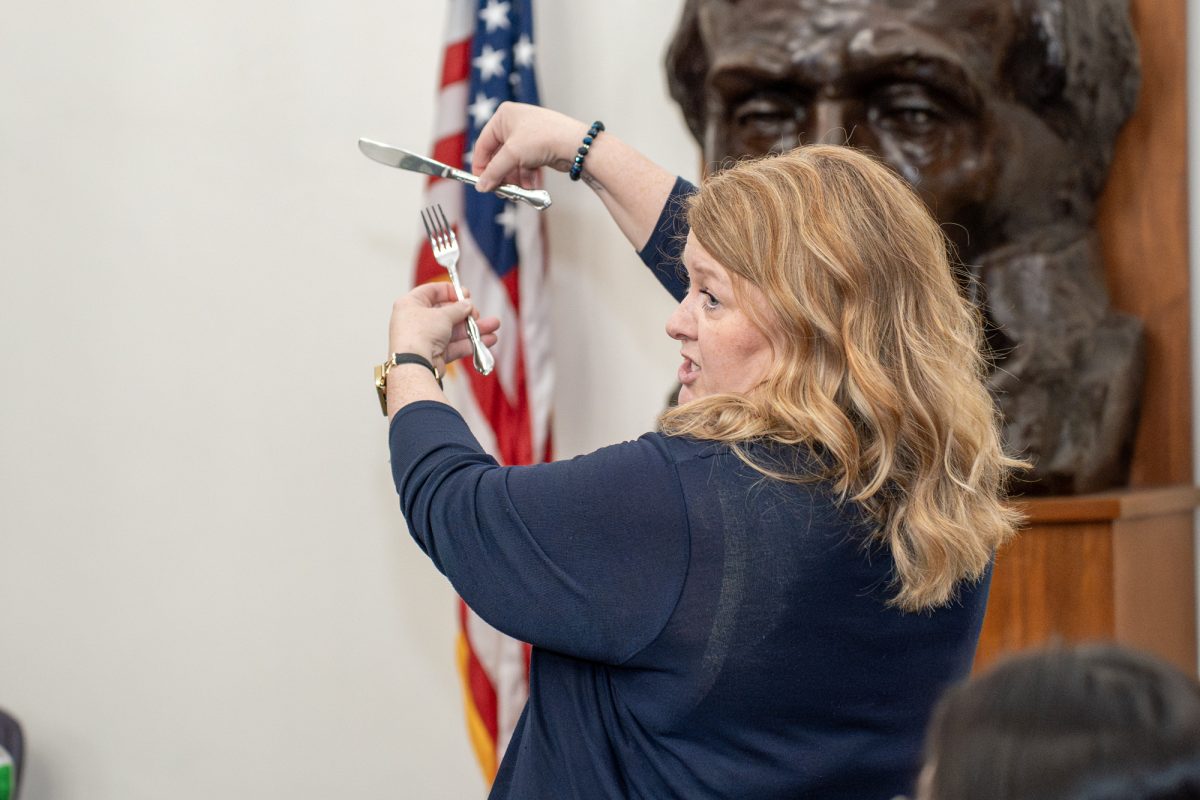
On April 2, the Student Senate hosted an executive board debate for candidates running for the 2026-2027 school year, allowing student candidates to advocate for their respective roles.
The candidates for the positions of President, Vice President, Treasurer, and Secretary were expected to answer questions from both current Senate members and students. As the debates progressed, speculation regarding the possibility of a candidate cheating due to unfair and suspicious behavior was made known to the senators running the debate.
Audience members witnessed a paper being passed from the current Senate Treasurer senior, Sikander Mateen, towards a running Treasurer candidate, who then took the paper to the table with them during debates.
Prior to the debate, it was made clear by President Subba that preparations for the debate were allowed; however, no executive board runner would have access to the questions asked during the debate, nor could they have notes while on the stand.
Once Subba and Jain viewed the paper in the candidate’s hands while going up for the debate, they immediately confiscated the sheet and stated it could not be used.
“None of the candidates were allowed to have papers or anything in general. And so we saw that, and we decided, no, you can’t have that during debate. So we can’t let you have that unfair advantage either,” Jain said. “Even if we aren’t asking you those questions [the questions from the forum], even if we don’t know what is on the paper, we don’t know what pointers you have. We can not let you have that as a reference material.”
After the note was confiscated, they learned of incoming anonymous questions for the live forum. A Google form was active during the debate, where students could submit questions to those in the running.
“Since the form was anonymous before, I knew that right at the moment that…there were only 14 responses that were submitted the day before, so there weren’t any responses added [before the debate]. But then I started seeing responses added on,” Jain said.
The note was confiscated before the debate could begin, and multiple Senate members brought the note to the attention of the Senate President.
“Our other senate exec members also brought [the cheating] to our attention,” Subba said. “Basically, what was happening was, most likely, they [those passing notes] were writing questions that were being submitted to the live audience questions and answer forum.”
Subba stated she had the chance to see the paper before she took it away from the candidate; however, she believed that the information on the sheet could be seen as notes of mentorship, writing down what a treasurer should know.
She stated that she understood the concern, but that this was not something that started during the debate.
Subba said that the issue is not whether the paper had tips or notes for the candidate to follow, but rather that the paper was handed to them during another candidate’s debate and handled improperly. She believes it is not cheating but rather mentorship. However, it is agreed that it should not have been done right then and there.
Subba said that the presidential candidates came to her for advice, much like the Treasurer candidate asked for mentorship from Mateen, who had passed the note, but because the presidential candidates did not ask in the public eye, it did not seem suspicious.
“[The candidate] asked for mentorship and that’s all she was getting, but the moment the public saw it, they just thought maybe you know it is suspicious, and I get those concerns, I understand,” Subba said. “I think that because it was in front of so many people and during [other] debates, I do see where the concern comes from…for me it was a shock and I did talk to them being like ‘you should not have done this’…” Subba said.
Subba and Jain also assured that regardless of what was on the paper, it did not affect the debate.
“I do believe it could have been handled better, but we were so focused on trying to make it [the debate] moderated heavily,” Subba said.
Jain stated she did not see the notes on the paper, but that in response to this discovery, the debate became heavily monitored from then on. Any question specifically asked towards the accused Treasurer candidate through the forum was not asked, and instead, a general version of that question was.
“All of these questions [submitted late] were not asked in the debate. We were heavily moderating that debate, and so after this happened, we decided to make the form non-anonymous so we could then see who was submitting those questions… and so we would not take those questions,” Jain said.
This moderation was not extended to the rest of the questions from the forum, and Subba and Jain assure that other people’s submitted questions were asked.
“We wanted whoever in the audience [who] was genuinely there to ask questions to the candidates to get preference… A lot of the time, we would make sure that none of the personal targeted questions would come forth, but [that] the important questions would be asked,” Subba said.
Barbar stated that the concern on her part was not whether it could be regarded as cheating or mentorship, but to work to not let it affect the debate.
“My goal was that whatever turns out, it could be… It’s better for me to prevent any kind of bias coming in, and if there is a bias I see that’s happening, whether it’s the way the questions are sent in the form or by having a paper, it’s better that we remove those. That we prevent that,” Jain said.
As a message from the Senate, Subba and Jain say they do not advocate for what happened, and that the debate was impacted as little as possible.
“We’re not sure. We’re not sure whether it was cheating, whether it was mentorship, but we prevented what was happening…my goal was that I prevent what was happening from making the debate unfair,” Jain stated
On April 13, an email was sent to the student district by the Student Senate and Jake McClean, allowing students to nullify their vote. Some students reached out to McClean, stating that they felt pressured in their votes. As a result, the Senate and McClean sent the email. It read:
“As many of you are aware through various channels, concerns have been raised regarding the methods used during this campaign cycle. My role is to ensure that our election process remains fair, transparent, and reflective of your authentic, unpressured choices….You will have two options: Keep your vote as is. If you feel your vote was cast fairly, you may choose to let it stand. [or] Nullify your vote: If you feel you were pressured, approached in a restricted area, or otherwise influenced in a way that violates the guidelines, you may choose to withdraw your ballot entirely.”
On April 17, the results for the 2026-2027 executive board were sent via email. The accused candidate for Treasurer was listed in the upcoming years’ Treasurer position.
According to McClean, of 101 students who filled out the new form sent on April 13, only 14 students nullified their vote.
When McClean was asked his opinion on the allegations circulating, he stated he found the whole incident quite interesting.
“The thing that strikes me about the whole thing is that there was more engagement on an anonymous platform [Yik Yak and Fizz] than there was in the actual voting process,” he said.
A total of 329 votes were cast, roughly 32% of Knox’s roughly 1,000-person campus.
“For the kind of level of engagement there, if we are talking about fairness, then vote. Participate in the process, make your voice heard,” McClean said.
Senate Secretary Jain and Subba wished to assure the student body that any of the actions taken at the moment of the debate were the best they could do.
“We took steps when we noticed what was wrong, and we took steps that could be taken at that moment to correct them. We also listened to a lot of opinions and had conversations. There’s a lot that happened inside that’s not seen outside…we did those efforts, and we weren’t just sitting idly,” Jain said.