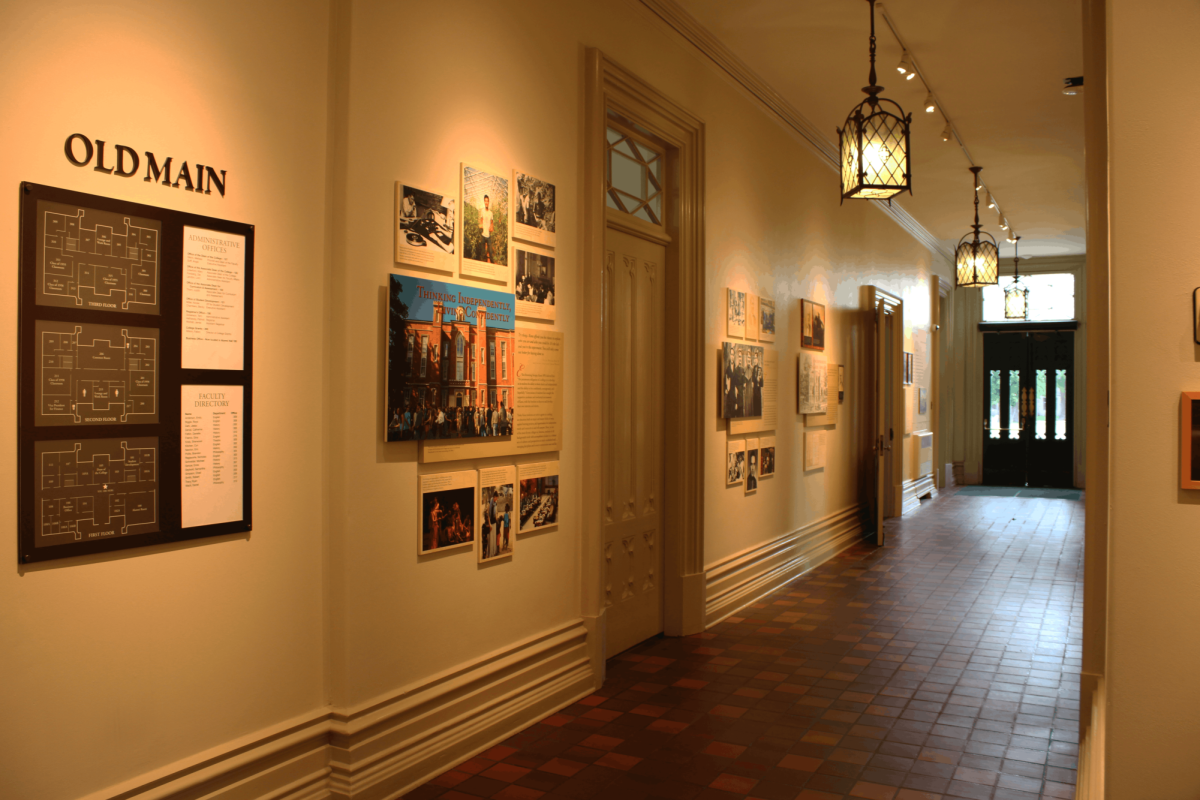
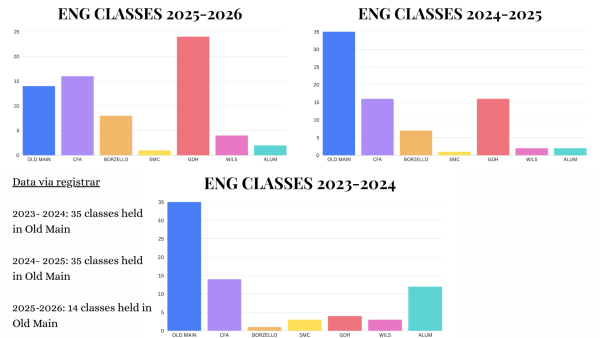
Old Main has been dubbed both a historic building and a city landmark of Galesburg, while also traditionally hosting most of Knox’s English classes. Over the course of the past three years, however, the number of English classes held in the building has decreased by approximately 60%.
Around 21 classes are no longer taught in Old Main this school year, according to a TKS analysis of course schedules in the registrar portal.
According to faculty members, such as English Chair Cyn Kitchen, this change is not at the request of professors, but rather a necessary step to improve class accessibility.
“What I want to make clear is that this is a matter out of the faculty’s hands,” Kitchen said. “We may request an OM classroom on our upcoming schedule, but ultimately, it matters who signs up for that class and what each student’s accessibility needs warrant…what matters most is that students are able to access our teaching spaces, and Old Main’s lack of an elevator makes that difficult for many and impossible for some.”
This is a common complaint of the building, as the steps within Old Main are uneven and fairly large. This shift from classrooms not only supports the fact that the building is inaccessible, but also brings to attention the lack of overall accessibility on campus.
Senior Lexi Sendall shared her concern via email regarding why she believed there is a need to create an accessible environment at Knox. She agrees that moving classes is a step in the right direction for accessibility, but it lacks prioritization.
“I think this highlights a more serious issue that accessibility has not and continues not to be prioritized highly enough by the administration at Knox,” she said. “Our most iconic campus building, which is supposed to signify the longevity of the Knox community, and is a significant part of our institution’s history, is mostly inaccessible to a portion of our community because the upper floors of the building have not been prioritized to be updated and meet ADA compliance standards.”
Sendall also states that this issue transfers to residential buildings and that, as a school that prides itself on inclusivity and diversity, Knox’s campus does not meet accessibility standards. She believes professors are making the right decisions to adapt to their classes’ movement, but states that the issue should be addressed.
“I applaud the English department for being willing to relocate their classes to prioritize the needs of students and create a more accessible environment; however, every building on campus should be equally accessible if we are truly to make strides in our accessibility initiatives as an institution,” Sendall said.
Director of Disability Support Services Stephanie Grimes mentions that this change is happening to more than just the English department, and that over the years, multiple classes there are typically held in their buildings of discipline are being moved elsewhere to meet the needs of the student population.
“Old Main, as beautiful as it is, it’s not an accessible building,” Grimes said. “So my responsibility is to…evaluate from a perspective of ‘what’s the accessibility need?’ And so sometimes there’s an accessibility need for a classroom to be on a main level floor.”
Grimes also mentioned that as the years go on, the student population is growing, and as such, the need for accessibility is as well.
“We’ve grown. You know, we saw this year already, I had 111 new students [who] have registered with disabilities of some kind of medical issue that they have. So it’s important for us to continue to assess those things, look at those things,” Grimes said.
With Old Main being considered inaccessible, as well as some residential areas, the question of how the school will move forward to meet accessibility still lingers.