

After my first watch of Josh Safdie’s ‘Marty Supreme,’ I remember feeling very confused. Here, when I say confusion, I don’t mean the sort of confusion that a complicated Christopher Nolan movie may evoke in a viewer. I mean confusion as a consequence of being out of sync with your own feelings about something.
‘Marty Supreme’ is a thriller dramedy about Martin ‘Marty’ Mauser, an elite table tennis player in the 1950s who was also a hustler. In the film, Marty is completely consumed by his obsession with winning the World Championship for table tennis. This mission motivates Marty throughout the film and serves as his overarching goal.. However, it is easy to forget that when you’re watching the film.
This is a film with a melting pot of subplots. Marty has to hustle and grind his way through the film, such as setting up tennis-based cons to extract money from people. At one point in the film, Marty joins his friend, Wally, a taxi driver played by Tyler, the Creator, to set up bowling alley cons where people play amateur table tennis games for money. This then leads to an interaction with a gang of disgruntled victims from Marty’s scams, where they attack Marty and Wally, even damaging Wally’s car, and lose all their money.
During this same attack, Marty and Wally manage to lose a dog entrusted to them by an old man, implied to be a rich and powerful gangster. He quits working for his uncle at a shoe store and steals some money from him to pay for his flight to the World Championship. He dismisses his mother’s calls and is in an on-off relationship with his neighbor and childhood friend, Rachel, who is cheating on her husband and eventually gets pregnant with Marty’s child. Throughout all of this, Marty is also trying to kickstart his own brand of orange ping pong balls, which are unlike the traditionally used white balls.
Running parallel to all of this, Marty maintains an affair with Kay Stone, an actress who was once one of the most famous actresses in the world, but now finds her stock dwindling as she tries to make a sensational comeback. As their affair continues, Marty tries to work for her husband, Milton.
This makes trying to understand the film a little more difficult than it really needs to be. The subplots can make the film feel overstuffed.
Plot and Narrative

The film has a narrative that is largely easy to follow. It’s linear and chronological, but has so many tangential plots that it becomes difficult to consider the entire film as a single unit. I wondered how much of the film’s induced confusion was intentional and how much of it was a consequence of a film that was confused about what it really was.
See, ‘Marty Supreme’ is hardly a sports film. The table tennis sequences and match sets are wonderful, and Chalamet’s years of table tennis experience shine in the project. Chalamet has reportedly been preparing for this role since his days shooting for the first ‘Dune’ movie. The preparation was in an effort to make the table tennis sequences feel more than two guys who picked up a paddle a few months ago.
However, these sequences take a backseat whenever the subplots come into play. The film is also not a heist, race-against-time film. While the film has a natural moment of urgency in Marty wanting to compete at the World Championship, it is easy to lose how urgent that aspect is when the film is focused on resolving another tangential plotline. Despite the shootout scene, the film is not an action film.
I imagined this film being in a similar fashion to ‘Whiplash,’ another film about a talented youth who is consumed by an obsession with a particular skill, and lacking guardrails to save himself from the perils of unhealthy devotion to something. However, the film was incredibly different simply because of the titular character.
See, Marty Mauser is incredibly unlikable. Throughout the film, he sees other people as opportunities and stepping stones to a larger success that is ‘destined’ for him. In a conversation between Marty and Kay, Marty says that the thought of losing and things not working out for him is an idea that “doesn’t even enter (his) consciousness.” Marty is so consumed with what he can be that he seems to forget he has to get there and be the best version of himself.
In films that are meant to be (or at least should be) cautionary tales against certain unhealthy obsessions and practices (like “Whiplash” and, to some extent, “The Wolf of Wall Street”), the characterization of the main character holds more importance since cautionary tales are usually character-driven stories. Likeable (or at least tolerable) characters like Andrew Neiman, from Whiplash, work for the audience because the story rewards a likeable character for his efforts. The audience wants to see the underdog win, and that is why Whiplash’s specific ending worked for that film.
In contrast, some cautionary tales must have their titular character be as unlikable as possible. Take Jordan Belfort from The Wolf of Wall Street, for example. Jordan was a very unlikable, very rich guy, and the audience follows Jordan from an awkward meeting with Mark Hanna to running his own firm and being a multi-millionaire. Jordan slowly loses the audience’s support because there is a natural showcase of character deterioration that is reasonable to digest. After a scene with Jordan trying to run away with his young children in his car, he is at the lowest point of his life, and the audience has limited sympathy for him because they have seen him transform into a morally and ethically corrupt man.
“Marty Supreme,” however, is a cautionary tale with no real consequence for a character that deserves grave consequences. Yes, Marty is unable to compete at the World Championship because of his own attitude and arrogance towards the organizers of the championship, but Marty’s ultimate goal has always been to prove that he is the best to himself. Yes, he wants the recognition for it, but Marty is so consumed with himself that he cannot fathom losing to Koto Endo and never playing him again.
When Marty then beats Endo, he proves to himself that he is the best, which is why he falls to his knees and cries and even embraces Endo afterwards. For him, this is the win he was so desperately after, and knowing that he beat the best is enough consolation for him. The film ends with Marty getting one last win for himself at the cost of his abhorrent treatment of everyone who isn’t Marty Mauser. He is difficult to root for, but for some reason, I found myself rooting for him many times during the film.
This is why the end of the film also feels flat for me. The final shot of Marty going to the hospital to see his newborn son, and breaking down crying at the first sight of his son, plays on clichéd tropes. Marty has not indicated any care or regard for any other person in the story so far. He gets his on-off girlfriend and neighbor, Rachel, pregnant and then leaves her alone after she is injured in the crossfire for trying to fix a situation that he created.
Marty also technically causes the death of multiple people. The dog he lost was captured by the person who lived next to the gas station where the dog ran away. Then, when the original dog owner goes to get his dog back, he holds Marty and Rachel hostage as collateral, but finds himself in a fatal shootout when the dog’s new owner refuses to back down. Even in situations like this, Marty steals the man’s money from the pocket of his corpse.
Marty tries to be a jack of all trades, but he truly does end up being the master of none. Yes, he is an excellent ping pong player, but he failed to realize the ultimate goal of winning the World Championship on a competitive scale. His win against Endo is fair, but it is more of a personal victory for him than a competitive sporting victory, as it was an exhibition match.
It is difficult to foresee a different future for Marty when the film ends. Yes, it is heartwarming to see Marty break down after seeing his son for the first time, but after the audience has seen Marty make all the wrong decisions and use everyone around him for his own gain for almost two hours, at that point, it is difficult to expect anything else than what we have seen and know to be true. The Marty Mauser that the audience has been following to the end of the movie is not a person one expects to be a good father, which makes the ending a little sad.
I can see the argument that losing out on the opportunity to compete in the World Championship, a tournament Marty was a favorite to win, is ample punishment and consequence for his actions. However, this argument does not consider that for the people Marty has exploited on his way to resolving the main plotline, they may see the punishment as lackluster. For all the people he has wronged in every other plotline, he seems to get away, scot-free.
Everything Else
The film is built to be carried on the titular character’s back, and Marty is the central character who connects all these different characters and plotlines. Timothée Chalamet played a great Marty Supreme. Yes, he was arrogant and somewhat unlikable, but that is exactly what a good portrayal of that character would showcase. Marty is consumed with a sort of arrogance that he explains as self-confidence, and it is clear to see that some aspects of Chalamet’s personal aspirations overlap with the character’s.
The major talking point from the film’s press tour and post-release discussion has been Timothée Chalamet. He was poised as the frontrunner to win the coveted Oscar for Best Actor in a Leading Role, and had an excellent campaign up to the point of the Oscars, with the film being nominated in nine categories in total. It did not take home any awards, which was completely on-brand and in-character for the sake of the film’s narrative. In the film, Marty dreams and loses big-time, which is what happened with the film in the awards ecosystem as well.
Chalamet, however, carries the film. He is excellent as Marty and brings an arrogant bravado to the table that makes him extremely unlikable but also captivating. Marty is someone you dislike but cannot bring yourself to take your eyes off of. He is interesting to look at and hear about. I was very surprised by Kevin O’Leary’s role in the film. I was apprehensive about O’Leary’s casting when the film was announced because it was difficult to separate O’Leary from his infamous Shark Tank role as an angel investor.
However, O’Leary was actually decent. He plays a compelling villain in Milton Rockwell, an influential and wealthy businessman who runs a mega-stationery tycoon. Perhaps the role of an evil businessman does not come as too much of an acting role for O’Leary, but it is the fact that O’Leary is not a conventional Hollywood star that actually adds to his role as Rockwell. He is a terrifying adversary for Marty and is someone with the power to fix all of Marty’s problems, but chooses not to, simply because he believes Marty does not deserve it.
Tyler, the Creator’s performance is also better than expected. At first, it is somewhat unsettling to hear and understand these characters because they do not talk in the same tone, accent, and cadence that one would expect people to speak like in the 1950s. Wally’s character sounds nothing like someone in the 1950s, but Wally is a fun, likable character that the audience can root for and a face that the audience can recognize.
Once the audience accepts and embraces the temporal shortcomings of the film, it becomes more enjoyable. Yes, it is disorienting to see a movie set in the 1950s, using music from the 1980s, and talking like they are in the 2020s, but once you suspend that disbelief, the movie becomes much more enjoyable.
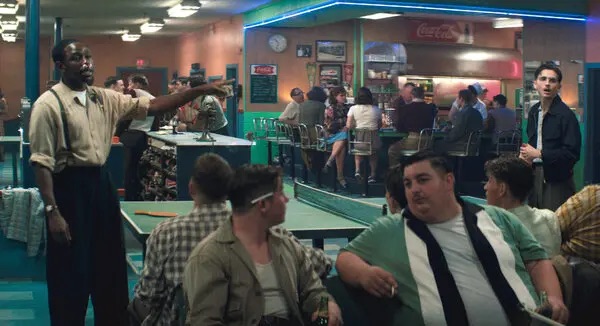
The production design and set were exceptional. A report stated that the director wanted the paint on the walls to be yellowed to imitate the effects of cigarette smoke in the 1950s, which is just a testament to the pursuit of accuracy and precision for the depiction of the times the movie was set in. The costuming and overall aesthetic of the movie are also intriguing and exciting.
However, the main talking point of the film is Marty. He’s a horrible person who steps over people like stepping stones for his own gain, but I couldn’t help but root for him a little. I found myself with a smile on my face when he stepped out of the jet onto the tarmac in Japan, which was a feeling I could not fully understand. Marty has an infectious capacity to him that pulls you in and convinces you of his dream. He is so convinced and sure of himself that you want to believe him, and a part of you wants him to win.
Timothée Chalamet truly gave life to this character. You can see Chalamet’s own influences and the lines being blurred a little between the reality of Chalamet as a performer and Marty as a fictional character. Both channel this athlete mindset, and his performance harkens back to Chalamet’s award acceptance speech, where he said that he is “chasing greatness.” The same part of you that dislikes Marty also interestingly wants him to win.
My Rating: 7.75/10