On Jan. 2, the United States launched a military operation in the capital of Venezuela, resulting in the capture of President Nicolás Maduro. Maduro’s administration, as well as the administration before him of former President Hugo Chávez, was described across news outlets and press releases as authoritarian and even dictatorial.
On a press conference on Jan. 3, the operation carried out by the U.S. was described by President Donald Trump as a kind of assault that “has not been seen since World War II,” Trump also addressed that the U.S. would be “running” Venezuela until further notice.
“Well, we’re gonna be running it [Venezuela] with a group, and we’re gonna make sure it’s run properly.…” Trump said.
No timeline nor details were disclosed about the U.S.’ plan to govern Venezuela.
According to information stated during the conference, the operation to capture Maduro was labeled “Operation Absolute Resolve” and was a joint mission by the U.S. military and law enforcement. Secretary of War Pete Hegseth stated that he believed the operation was a great success and a display of America’s power.
“As the president said, our adversaries remain on notice. America can project our will anywhere, anytime. The coordination, the stealth, the lethality, the precision, the very long arm of American justice, all on full display in the middle of the night. Nicolás Maduro had his chance, just like Iran had their chance, until they didn’t and until he didn’t. He effed around, and he found out,” Hegseth said.
This operation, however, has left people with conflicting reactions—especially the citizens of Venezuela and other Latin American countries. A Knox student from Argentina, senior Luvina Vilapriño Aguirre, who was home for winter break during the U.S. operation, spoke about her exposure to the news and feelings towards her fellow South American country’s new political climate.
Due to Argentina and Venezuela being nearby countries, and both at some point having been ruled by a dictatorship, many experiences and hardships were common knowledge to Aguirre.
“Since the old [Venezuelan] president was in power [Chávez], I knew it was a dictatorship. We saw it on the news every day. More and more Venezuelans fled to Argentina. It wasn’t something we were shown, but something people lived. It might not have been taught in schools, but if you went home or listened to the radio, you knew what was happening,” Aguirre said.
Aguirre was in her room when the attack on Venezuela occurred. She had fallen asleep before anything took place and was woken up by her frantic mother. Freshly awake, she feared the worst.
“Argentina’s previous government threatened a golpe de estado [coup d’état] to become a dictatorship. I woke up thinking that had finally happened, but when I was fully aware, my mother told me that they [the U.S.] had taken Maduro,” Aguirre said.
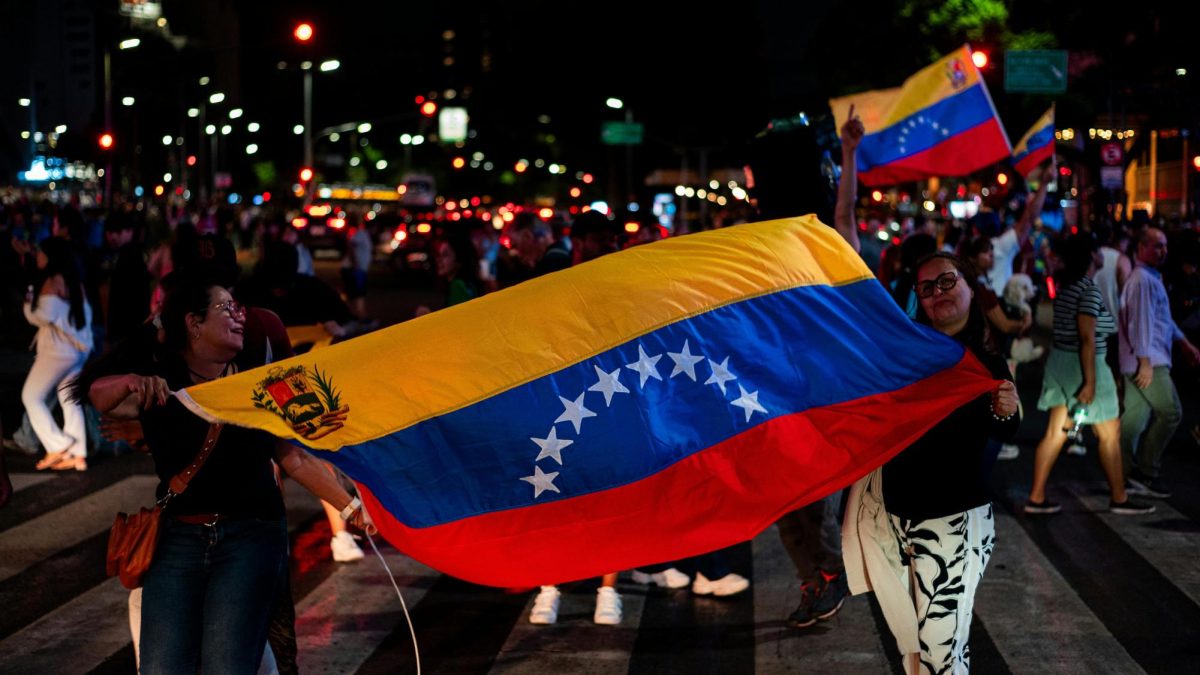
After the news of Venezuela’s freedom, many reactions across the world varied from overjoyed to fearful. Although Maduro was removed from direct control, Venezuela remains under U.S. authority and the elements of the remaining Maduro administration.
“There are two perspectives,” Aguirre said. “Happiness for Maduro leaving because his administration tortured people, withheld proper education, food, and medicine. But the other perspective is worry over what happens next.”
She added that some people have worried the U.S. will exploit Venezuela’s oil resources.
“They [the public] say Trump is going to drain the oil from Venezuela, but Maduro has already done that,” she said. “There was no other way to get him out of power. It had to be by force.”
Aguirre mentioned Argentina’s dictatorship under General Jorge Rafael Videla from 1976 to 1983 as a reason for her understanding of Venezuela’s conflict.
“When my mother was under a dictatorship in Argentina, you could get in trouble for anything. Expression, reading anything against the government, or being alone,” Aguirre said. “Someone who has never lived through a dictatorship doesn’t understand the happiness people feel being liberated because they have never felt the pressure of not feeling safe in their own country.”
Venezuelan opposition leader Corina Machado posted a statement on X on Jan. 3, shortly after Maduro’s capture, stating that Venezuela’s time for freedom had arrived.
“This is the hour of the citizens,” Machado wrote. “Those of us who risked everything for democracy on July 28th [the 2024 Venezuela Election]. We who elected Edmundo González Urrutia as the legitimate President of Venezuela, who must immediately assume his constitutional mandate and be recognized as Commander-in-Chief of the National Armed Forces by all the officers and soldiers who comprise it.”
Machado has also stated her gratitude for Trump’s involvement in the capture of Maduro. A press release on Jan. 20 quoted Congressmen Carlos Giménez and Mario Díaz-Balart, along with Machado, giving thanks to the U.S. president.
Aguirre discussed why no other actions could be taken but to have U.S. involvement.
“Without the U.S., Corina Machado can’t do much,” Aguirre said. “She needs support from people with a lot of power and money to push Maduro’s control, [and] Latin American governments can’t support her efforts. Giving all that money would leave their own citizens even poorer than they might have been, and vulnerable if they also gave their own military help.”
Aguirre stated that freedom for Venezuela, regardless of who accomplished it, is still better than what the government was before.
“Between Maduro and Trump, it seems better to have Trump,” she said. “It’s not going to be easy for Trump to gain control, but at that moment [Maduro’s capture], people didn’t care who took power. More so that Maduro wouldn’t be in power and that his regime would end.”
The United States’ involvement in international relations has left many questions with respect to the U.S.’s legal ability to govern Venezuela. In an ABC exclusive interview, journalist George Stephanopoulos questioned Secretary of State Marco Rubio regarding the legal authority allowing the U.S. to “run” Venezuela.
“What we are running is the direction that this is gonna move, moving forward…” Marco Rubio stated in the interview. “The leverage we have allows us to seize any sanctioned boats coming into or out of Venezuela, loaded with oil or on their way to pick up oil. We can pick and choose which ones we go after…That will continue to be in place until the people who have control over the levers of power in that country make changes that are not just in the interest of the people of Venezuela but are in the interest of the United States and the things that we care about.”
Again, Stephanopoulos asked Rubio about the legal grounds to run Venezuela after Maduro’s capture. According to Rubio, the U.S. has court orders to seize the oil in Venezuela.
He states in the interview, “Is a court not a legal authority?”
It has not been confirmed whether the United States holds legal authority to govern Venezuela.
Aguirre stated she has hope for Venezuela’s future. She hopes to see them move towards a better government, one that existed before the Chávez and Maduro administrations.
“Hopefully, the administration of Maduro leaves,” she said. “It will take many years, but hopefully they gain safety back, gain independence, and better living conditions. I think the best that could happen, right now, is that in five years, they are at least in the direction [emphasis] of being how they were before their dictatorships. I think, despite the circumstances, everything will be for the better.”