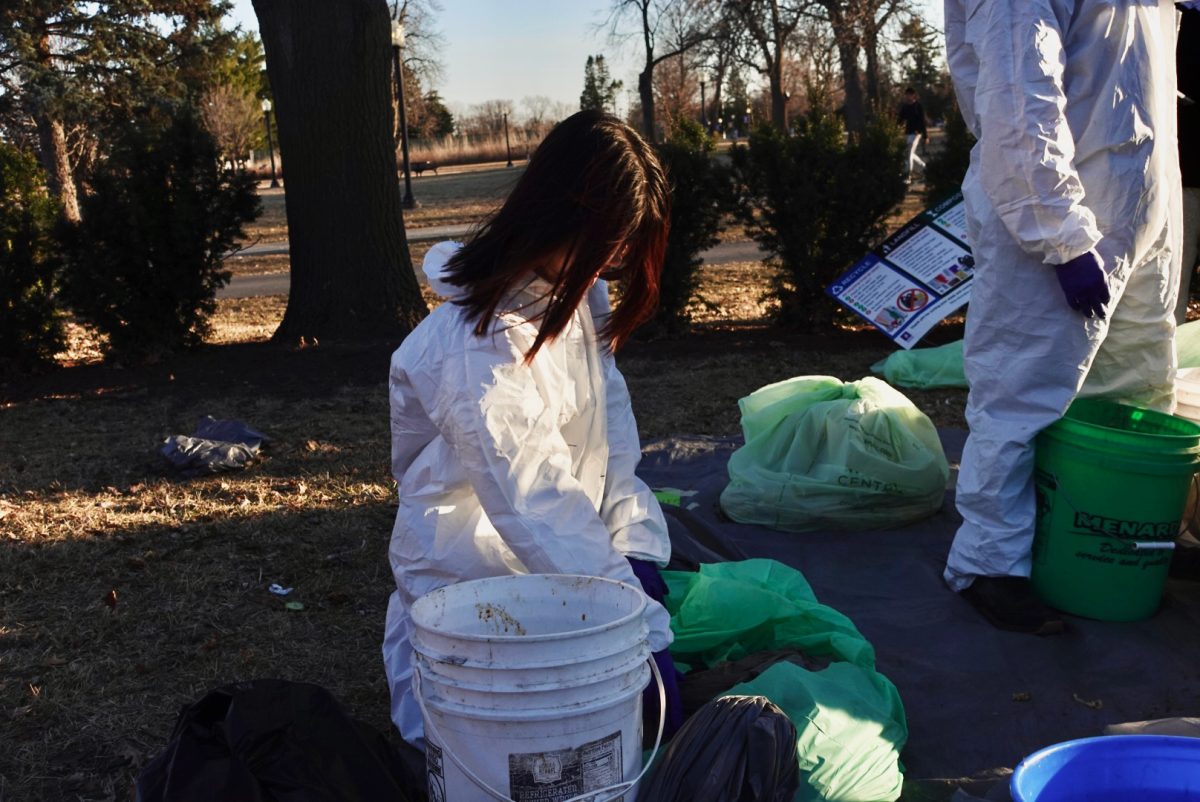
Knox has once again joined 96 other colleges and universities across the U.S. and Canada in a campaign called Campus Race to Zero Waste. The eight-week-long movement and competition started Feb. 1 and goes until March 28.
Junior Nicole Roman, who is involved in sustainability leadership roles at Knox, explained what Campus Race To Zero Waste is.
“The focus is to see…the several different ways a campus can address waste, from repurposing materials to diverting waste from the landfill, focusing on composting, recycling, all those several different ways, and then seeing what that grand total diversion rate is at the end of those eight weeks,” Roman said.
According to Roman, it made sense for Knox to join this nationwide campaign because students and staff are already participating in waste reduction and diversion through various sustainability initiatives. She said some of these examples are using food scraps as a resource for composting, repurposing materials at the free Share Shop, and engaging in non-traditional recycling, which involves collecting items like batteries that cannot go in regular recycling bins.
“Plugging into Campus Race to Zero Waste allows us to remember all the work we do and highlight it, and also participate in something that a lot of other colleges and universities are contributing to,” Roman said.
Director of Sustainability and Resiliency Initiatives Tina Hope said that Knox’s involvement in Campus Race to Zero Waste precedes her time as director and that when Knox first participated, it used to be called Recycle Mania. According to Knox’s Annual Sustainability Reports, Knox won Recycle Mania’s food organics category in 2018, the first year Knox participated, and then again in 2019.
“Each year, we vary on how we approach our way of contributing to Campus Race to Zero Waste,” Roman said. “Last year, we did themes biweekly, but this year, we’re leaving it open to, again, just emphasizing the work that we do.”
Roman is co-president of Students for Sustainability (S4S), a Sustainability and Resiliency Project Leader (SRPL) for the Office of Sustainability, and is involved in other sustainability leadership roles across campus. Helping to organize events for Campus Race to Zero Waste, Roman said the preparation and execution have been going well.
“I’ve been at Knox for three years, and I’ve been in these roles for two years, since sophomore year and this junior year,” Roman said. “And I feel like each year, it gets stronger and better, and we’ve really solidified a good team within SRPLs and within S4S exec. And we just have a really good, passionate crew that is really eager to do this work.”
Monitoring & measuring waste
To begin the Campus Race to Zero Waste, S4S held a kickoff event at their weekly meeting on Jan. 26 to announce upcoming plans and recruit volunteers. Roman said that at the meeting, the team presented data collected from past waste audits, using the results to guide their goals this time.
One focus of waste diversion on campus is making use of and reducing contamination within the three-way bin systems for landfill, recycling, and compost. Many of the single-use dining items in the cafeteria and Gizmo can be industrially composted.
Knox pays Better Earth Logistics to pick up these compostable items and compost them at their Peoria facilities. When items that cannot be composted are mixed into the bags, it contaminates the system, and the college gets fined. Similarly, contamination within recycling systems — when things that can’t be recycled are put in the blue bin — often results in the whole bag ending up in the landfill.
Even before the official start of Campus Race to Zero Waste, volunteers were hard at work reducing contamination in dining location bins. Roman said that S4S volunteers helped people sort their waste during International Week at both the Interfaith Dinner on Jan. 27 and the I-Fair Food Fair on Jan. 31.
“Both of the waste monitoring events went very, very well, which we were all happy about, considering the Campus Race to Zero Waste didn’t start, and things were going awesome,” Roman said.
With Campus Race to Zero Waste now officially underway, volunteers also coordinated waste monitoring at the ultimate frisbee Winter Whiteout tournament on Feb. 14 and 15.
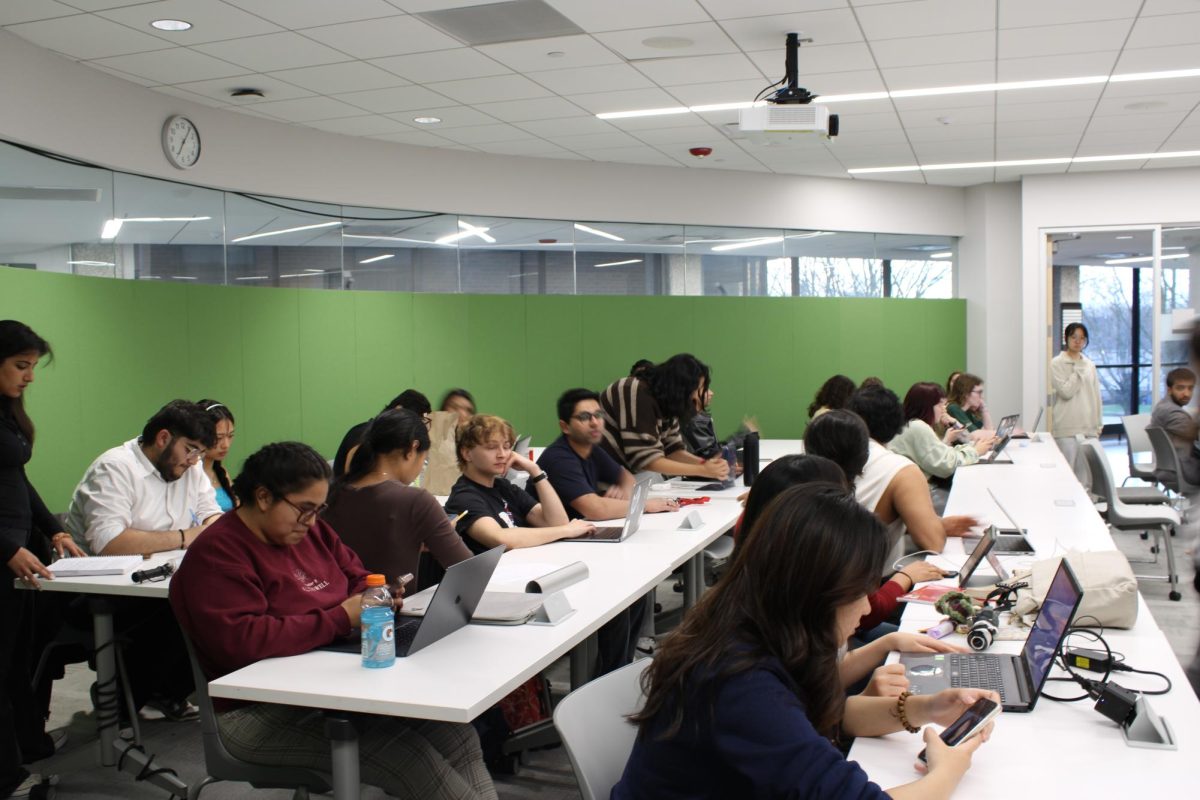
To gather data on current usage of the three-way waste bins, S4S and Food Recovery Network organized a waste audit on Feb. 25. Volunteers collected the bags from all five locations of three-way bins on campus as they filled up throughout the day. They went through each bag, moved contaminated items to where they should go, and weighed bags before and after re-sorting. This is to calculate the weights of contaminated materials and contamination rates, and to note what items are most often sorted incorrectly to understand what to focus on improving in the future.
Events & organizations
In addition to waste monitoring and audits, the Office of Sustainability and S4S have partnered with various groups on campus to host events that build engagement and awareness about waste diversion efforts.
The Office of Sustainability is hosting Knox Farm Soil Health Day on March 6 from 4 to 5:30 p.m. at the Knox Farm. Attendees will get to learn about soil health through hands-on activities, including seed starting, pruning, mulching, and learning how to make, screen, and apply compost to prep garden beds. This event aligns with the Illinois Stewardship Alliance’s Soil Health Week, happening the first week of March.
Roman also highlighted ways people can participate in ongoing opportunities.
Food Recovery Network is a group that partners with the Knox cafeteria and organizations in Galesburg to distribute surplus food to the community. Volunteers are needed, and meetings are every other Tuesday at 4 p.m. in the Carl Sandburg Lounge in Seymour Union. The next meeting is on March 3.
Makerspace student workers and the Office of Sustainability have been leading weekly workshops in the Makerspace from 4 to 5 p.m. every Monday this term, focused on learning to use Makerspace equipment through practical, sustainability-focused projects.
The Share Shop is open, for both free shopping and volunteering, from 4 to 6:30 p.m. on Thursdays, Fridays, and Saturdays. When classes end, Roman said there will be a spring cleaning event in the Share Shop to sort donated items.
Information about these groups and events can be found in the Sustainability newsletter, emailed to the campus community every Monday.
Earlier events for Campus Race to Zero Waste included a mug swap and herbalism workshop on Feb. 9, a quilting and upcycling workshop on Feb. 16, and a plant propagation event on Feb. 23.
When Campus Race to Zero Waste comes to an end, Roman said people can expect to see an email highlighting the work done throughout the eight weeks and carrying the momentum into the upcoming Earth Month.
Moving forward
How has Campus Race to Zero Waste been going so far?
39 percent of the documented waste on campus was kept out of the landfill in the first week. The diversion rate increased to 48 percent in week two and 60 percent in week three.
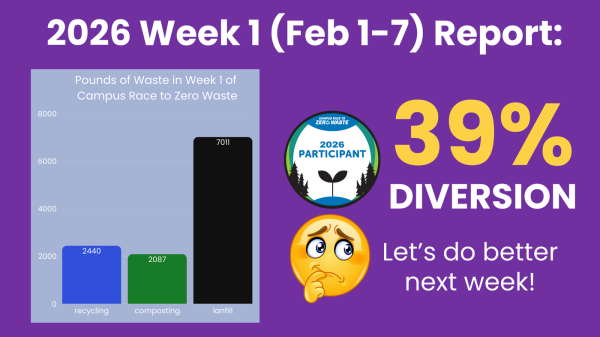
Week one report, sent in the sustainability newsletter on Feb. 9. Credit: Knox College Office of Sustainability
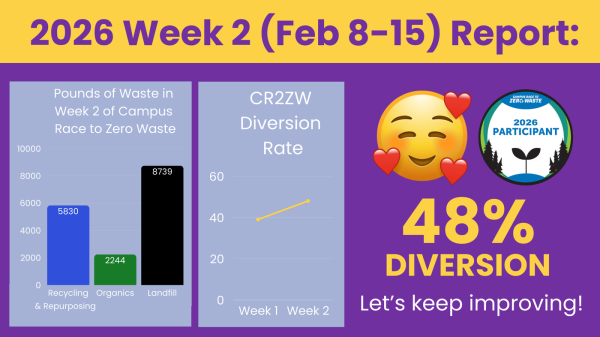
Week two report, sent in the sustainability newsletter on Feb. 16. Credit: Knox Office of Sustainability
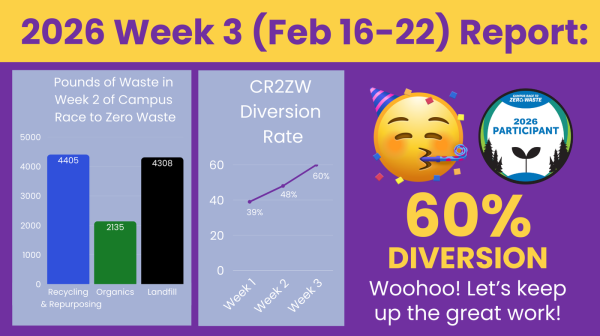
Week three report, sent in the sustainability newsletter on Feb. 23. Credit: Knox Office of Sustainability
Winners of the Campus Race to Zero Waste will be announced April 30, but the scoreboard will be updated periodically throughout the competition as schools report their weekly diversion data. As of Feb. 23, Knox was ranked second place in the per-capita recycling category, tenth place in two categories — diversion, and reduce food loss by food rescue — and 13th place in diverting food waste.
However, Knox’s long-term waste diversion goals go beyond the competition.
Roman said that Knox’s diversion rate during Campus Race to Zero Waste last year reached 45 percent, and this year’s goal is 55 percent.
“So I think that’s completely possible as we expand the work that we do, and the knowledge, and really rely on one another,” Roman said. “And as people become more comfortable with the different initiatives that we have, like the three-waste bins around campus. That’s very new; it’s only been really like a year and a few months, so people have to become a little bit more comfortable with everything and comfortable with asking, ‘Does this go here? Or where can I go to do this?’ But I think each year it’s getting better.”
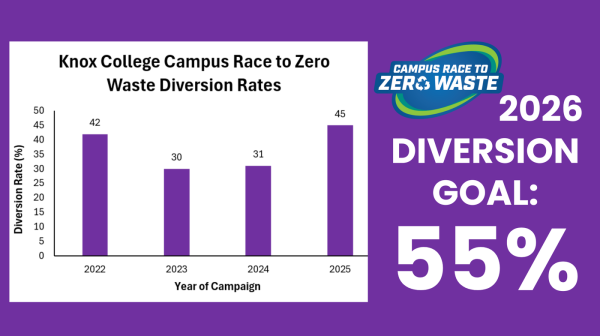
Knox’s Campus Race to Zero Waste diversion rates 2022-2025, sent in the sustainability newsletter on Feb. 9. Credit: Knox Office of Sustainability
Hope also said there has been significant progress, especially through the challenges of collecting data that demonstrates these improvements.
“I think we’re diverting more than we are reporting. We just don’t have it documented,” Hope said.
This year’s Campus Race to Zero Waste goal of 55 percent diversion is a step towards larger goals from the college’s recently announced Sustainability and Resiliency Action Plan. One goal from this action plan is for Knox’s waste diversion rate to be at least 75% by 2030.
“We’re really pushing towards [20]28,” Hope said. “We would really love 100 percent diversion, but we know that’s not likely going to happen. But we’ve already made really good shifts.”
One of these shifts, Hope said, was the college buying Water Monster bottle fillers to use at large events like graduation instead of plastic water bottles.
“So we’re making good choices in that way,” Hope said.
Roman hopes that people continue to stay engaged in this work.
“A lot of the work that we do, even though it might seem like little actions, they’re contributing towards something really big, and it is also just all super meaningful,” Roman said. “So I would encourage people to stay in tune, look at their emails [for the] sustainability newsletter on Mondays, and just to lean on each other, and just stay inspired, and stay hopeful.”