Knox College recently published a Sustainability and Resiliency Action Plan outlining goals for the next five years.
“We’ve already been doing a lot of this work. Now we’re just institutionalizing it,” Director of Sustainability and Resiliency Initiatives Tina Hope said.
The plan is organized into different aspects of sustainability and resiliency that the college will focus on.
The ten sections in the plan are:
- Leadership
- Learning and teaching
- Research and creative work
- Energy and transportation
- Water
- Food systems
- Land management and biodiversity
- Materials and buildings
- Waste and recycling
- Community engagement and well-being
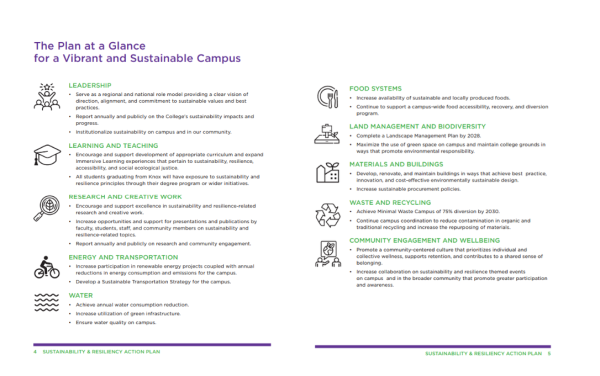
Snapshot of the Sustainability and Resiliency Action Plan. Credit: Knox College.
Each of these ten sections has two to three goals within it. Each goal then has several strategic action items that specify what will be done to meet the goal. The strategic actions incorporate different departments, offices, and initiatives across campus. More about each goal and the strategic actions within them can be found in the plan linked here.
The action plan was made through collaborations across the campus community and has been in development for over a year.
It was created by the Sustainability Working Group, which formed nearly three years ago and is composed of faculty, students, and staff from a variety of roles, including dining services, administration, athletics, facilities, and more.
Hope co-chairs the group with Vice President for Administration and General Counsel Brad Nolden. Hope said that the president’s office asked the Sustainability Working Group to create an action plan. She and Nolden began brainstorming what to focus on in the plan about a year and a half ago by drawing ideas from Knox’s 2023-24 Association for the Advancement of Sustainability in Higher Education report. Then, they presented this list to the Sustainability Working Group, and the group collaborated to change and refine it.
“We thought the action plan needs to be, not just some kind of lofty plan that we can’t really do this stuff, but rather a plan that’s like, ‘Let’s lay it out. How might we do this, each part of it?’” Hope said. “And we have these strategic actions. These are actionable items that we can work on together and we really feel are attainable. They’re ambitious, and they’re attainable if we can do this well.”
Teagan Springer, Assistant Director of Sustainability and Resiliency Initiatives, said it took time to create the structure of the plan because even slight shifts in the title of a category changed what goals could fit within it.
“We tried to keep thinking about the big picture, but then assessing how we break it up, and thinking about those different chunks, and how to best create a structure that allows us to talk about all these different intertwined ideas that we have,” Springer said.
This is Knox’s first strategic plan focused on sustainability. Springer said having the college’s support for the plan has been helpful.
“Because it’s always been like, yeah, Knox cares about sustainability. We have an office of sustainability, and we do stuff, and people individually try their best, also,” Springer said. “But for the school to release a plan that says, as a whole, ‘This is what we’re committed to and what we want to work towards’ — it’s just really helpful to bring in people who might not have understood where their role is in this whole goal, to understand that we can all be working together on that, and it’s a priority.”
Hope agreed that collaboration and community will drive progress.
“We are facing a lot of difficult times. And if we can come together as a community and work together on these shared values here, where we live, that really, to me, feels like it’s really transformative, and it feels like there’s stuff we can do. Despite the hardships and the challenges around us, we, together as a community, can do this,” Hope said.
According to Hope, challenges such as budget and labor shaped which goals were realistic enough to include in the plan, but the focus while creating it was identifying Knox’s resources and making the most of them.
“I feel like we did a really good job recognizing what we are capable of. And they’re realistic goals. And let’s hope to say in three to five years, we’re like, ‘wow, we did a lot of that.’ And I think we would have worked towards it with an action plan, or we would have worked towards it, anyway,” Hope said. “This gives us something, really, to demonstrate, because we do have a goal. We’ll start to post on our website how we’re doing with it, too, which is exciting.”
Besides financial and labor constraints, another challenge is increasing involvement from the community.
“Everyone is busy, and everyone is really concerned with their own activities, and that’s very valid,” Springer said. “Everyone has a lot on their plate, and it’s hard to take that brain space and that time to dedicate yourself to other causes, or maybe doing something more sustainably might take a little more time or effort, and for some people, that’s really unfathomable.”
Another challenge that Hope and Springer both mentioned is documenting data, especially when third-party certifications are involved.
“A smaller, less existential issue is that data is really difficult to just document the things and to get everyone working in these minute ways of, ‘I did measure that, and I will report that to you, and we can all share that data and get involved,’” Springer said. “We can make progress on things, but how well can we track it depends on different collaborations and can always feel tricky.”
Hope added that being at a small institution helps make communication across departments easier, and she said data collection and sharing will continue to be refined.
Another challenge Hope described is distributing information in a way that people pay attention to. She said the Office of Sustainability sends a weekly newsletter, but that doesn’t mean everyone reads it.
“We’re putting stuff out there all the time, and invitations, and it doesn’t mean people are actually seeing them. And so we will still hear people say, ‘Oh, I didn’t even know about all this.’ That’s a challenge, too. How do we keep making this aware[ness] in other spaces in other ways, which is something we’re still working through,” Hope said.
Despite these challenges, Hope and Springer are excited about the ways that sustainability work lends itself to the whole Knox community.
“It connects across campus. It’s completely interdisciplinary. And once we’re able to do this, bring that sensibility into all parts of campus, I believe we can actually achieve these goals. And so it comes back to us all working together,” Hope said.
Working together does not only mean within the Sustainability Working Group. Multiple parties connect with sustainability at Knox, and Hope wants to continue strengthening those relationships.
“I do feel like we have support of the administration. And increasingly, I hope we have even more support from the board of directors and alum in this work. Because I think it goes beyond just the campus community,” Hope said. “It extends to our alum, wherever they are in the world.”
Hope added that the action plan allows Knox to be a global leader in sustainability.
“And so we have the potential to be leaders, not just as staff and students and faculty here. We have the potential to be leaders in the whole world because we’ve got alum all over the world. And if we can all engage this work together wherever we are, I feel like that really starts to situate Knox College in a place of leadership in the realm of sustainability and resiliency,” Hope said.
The next steps for the action plan will involve further breaking down the specifics of the goals within the plan.
“I think one of our soonest big projects is just to really further plan this out, kind of make a plan for our plan, because we tried to be pretty specific in the plan and talking about how we’re going to accomplish this, but we still need to talk about how are we going to accomplish these other components to put all these other things into action,” Springer said. “On the agenda is making these sub-plans and working out those details, and we hope to have even clearer roadmaps to share with the community soon.”
While future Knox sustainability initiatives will fit into the action plan goals, Springer and Hope are open to other steps that become possible later.
“I would say that we’re not limiting ourselves to what we’ve stated in the plan. If something somehow becomes possible, even if it’s not in the plan, that’s awesome,” Springer said. “This isn’t the roof for us, but it’s the ground of what we’re really working towards and think is realistic, and we’re open to all sorts of other dreams and possibilities.”
Hope and Springer both expressed a desire to continue collaborating with anyone who wants to get involved.
“While the plan is done, and people can’t still give us feedback on writing the plan, there’s all sorts of more feedback and involvement to be had in, ‘how can we make these things happen?’” Springer said. “So if anyone has further ideas, or feedback, or questions, or wants to get involved with us in making this happen, there are lots of opportunities, and you should reach out.”