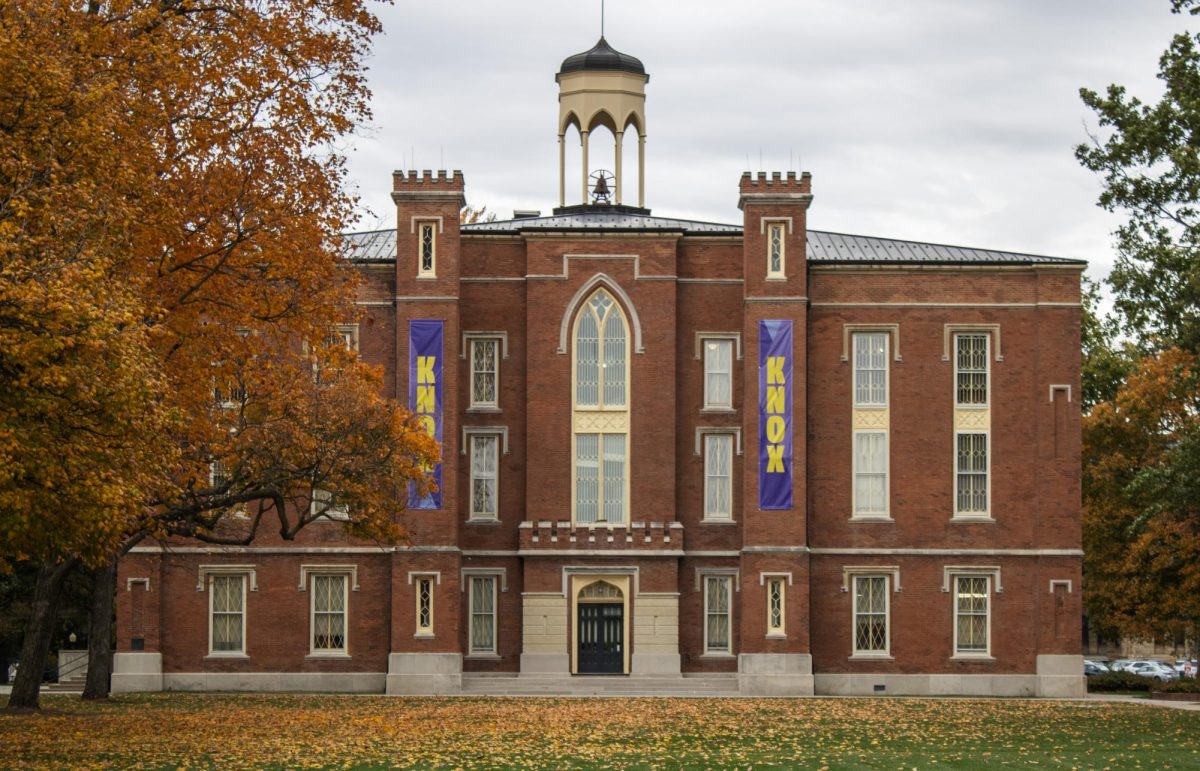
Student employment changes have been affecting students as Knox navigates ongoing financial and strategic development challenges. Some students are eager to be employed but are still searching for jobs, and others are feeling the impacts of the institution’s new initiatives on their positions.
One example includes students who were unexpectedly let go from their jobs and did not understand why.
Senior Manavi Subba was laid off from the Founders Lab this summer after working there since the fall of her sophomore year.
“I was laid off from Founders Lab without any communication from the department, and I know of other students who went through the same experience as me,” Subba said. “No one informed me that I had been laid off. I actually had to find out on my own.”
Subba found out she was laid off after her friends received the lab attendant schedule for the fall term, and she did not. She reached out to the department several times seeking answers, but said she did not receive the level of clarification she wanted.
“Even if it was because they needed less employees, I wish I got that information,” Subba said.
She then received a reply stating that Knox had made changes to the number of lab attendants needed and that questions should be directed to Chief Information Officer James Stevens.
Subba said this was a frustrating response.
“The lack of transparency and communication made the situation extremely stressful and confusing,” Subba said.
She said after that, it’s been difficult searching for a new job.
“Part of the challenge is that there’s no clear, consistent communication between the administration and students about available positions, changes to employment, or procedures we’re supposed to follow,” Subba said. “It often feels like students are left to navigate everything on their own with little guidance or updates, which only adds to the frustration.”
Stevens said that the IT department is restructuring positions so that student workers have more direct supervision from IT staff and can gain real-world experience. He said that the department is shifting towards offering jobs with more transferable skills, such as a new programming position.
Stevens said the initial number of lab attendants is no longer necessary, since students can use their own devices rather than rely on the lab computers, and use Knox’s new 24/7 helpdesk service as needed.
“Given all those changes, the usefulness of these lab attendants is not significant and did not provide useful experience for the students,” Stevens said.
However, it was a job, and Subba is not alone in losing hers.
Senior Sikandar Mateen said that he knows many people who unexpectedly lost their jobs this summer. He said it seems like some seniors are now struggling to find a new job because departments tend to hire younger students who will stay in the job longer.
During a student forum held by senior staff on Oct. 30, Vice President for Administration and General Counsel Brad Nolden stated that it is up to each department whether they want to continue employment with a student into the following term.
“Any position is not always guaranteed beyond the term you were hired,” Nolden said at the forum.
The two-job limit
This fall, a new rule was introduced regarding student employment: students can work no more than two different jobs on campus.
The 2023 policy that students cannot exceed 15 hours per week or 30 hours per pay period is still in place.
Students who had multiple jobs, such as sophomore Yusei Kaburaki, had to choose which positions to keep. Kaburaki started working in the mailroom as a first-year student last year. He had also been accepted to two leadership positions for this academic year as a resident assistant (RA) and Sustainability and Resiliency Project Leader (SRPL).
This past summer, students received an email outlining the new two-job limit. Initially, Kaburaki thought that student leadership positions would altogether count as one job, but he soon learned he had to quit one of his positions. He chose to leave the mailroom.
He said he felt bad for his boss because she was looking for long-term employees.
“When I joined, there were a bunch of fourth years. So they needed people because they needed people who were trained well. And they trained me well for the job. Suddenly I had to leave. Ultimately, it was my decision because I could have chosen to not do RA or something. But I also had my prioritization,” Kaburaki said.
He said that being accepted into his student leadership positions was a big deal for him, and he wanted to take advantage of the opportunity to develop the skills he would learn in those positions.
Besides requiring that students with multiple jobs choose between their positions, the two-job limit also means that some students who would otherwise be eligible to work more hours are prevented from applying for new jobs.
Senior Sarah Strauss, who works as an Admissions Ambassador and an SRPL, said that she enjoys her jobs but would apply for additional jobs if she were allowed to. Her two positions can only guarantee her about five hours total per week.
“The maximum number of hours that we theoretically can reach is 15, but I’m getting nowhere near that because my jobs can’t give me those hours. So I would be able to do that if I picked up another job, and that would be a way to supplement that, but it becomes really difficult when the limit is on the number of jobs and not the number of hours,” Strauss said.
Still, Strauss said that the work she is doing in her jobs is meaningful to her, so she is continuing to stick with them rather than looking for jobs that could offer her more hours.
Different jobs offer different numbers of hours because departments have different budgets and needs. While each department has to work within the number of total hours they are allowed to offer to student workers, it is up to each department how many positions to divide those hours between, including the number of hours a student may work per week.
Nolden said in the forum that Dining Services has started limiting student workers to seven hours per week.
Nolden recommended that departments limit hours to seven per week so that more positions are available. However, this suggestion is not an official requirement.
“The direction to my team is to look at and decide what is best for their operation. Sometimes that means limiting to seven hours, but there is no hard rule that they can’t schedule 15,” Nolden said at the forum.
Senior Patience Wagner said that some campus positions might align more with a student’s passions but might not pay as many hours as they need, so they might not be able to do what they’re interested in. They have to weigh their options carefully under the two-job limit.
“If you’re working on the Knox Farm, you probably can’t get too many hours working there, but [if] you still want to keep doing that, then your other job that you get has to be one that can provide you with enough hours to reach that mark. Right now, that’s just being limited for students, so I feel like then you have to choose between what you’re actually passionate about or interested in and where you can just literally get enough hours to make money,” Wagner said.
Wagner added that working off-campus to supplement income could be an option for some students, but it is just not an option for others.
Senior Eesha Rizwan agrees.
“I’m an international student, so I can only work on campus, but a lot of my friends, they work off campus, so they didn’t really care about the two-job limit,” Rizwan said.
International students who can only work on campus and any student who heavily depends on the income made from their jobs are being affected the most.
“I think if you’re only working on campus because you need the hours, it definitely is going to negatively impact you, but if you just wanted to be involved in the community, a lot of the jobs will give you equal opportunity in that sense, so I don’t think it impacted those people,” Rizwan said.
Stipend positions will not count towards the two-job limit—yet
Several jobs at Knox, including RA positions, Student Senate, and club positions, are paid with stipends instead of hourly wages. Since fall, the plan was that stipend positions were going to start counting towards the number of jobs a student held beginning in January 2026.
However, at the Oct. 30 forum, Nolden announced that stipend positions will not start counting towards the two-job limit until next fiscal year, which starts July 1.
At that point, stipends will be paid hourly. This includes positions such as RAs who are “on the clock” roughly 24 hours a day.
Nolden said pushing back this policy is going to allow departments and organizations to plan more for the changes.
“I’m not saying we’re not going to do it, but we’re going to get feedback,” Nolden said.
Nolden said it will also take time to figure out how to convert stipend positions into hourly jobs.
“It seems to me that RAs spend more time than other leadership groups, and there will probably be a tier list of expected hours to allocate numbers for student leadership positions,” Nolden said during the forum. “More information will be distributed before the start of the year.”
Kaburaki, an RA, said that it’s hard to estimate the number of hours an RA works — especially for duty-RAs, who are on-call for the RA phone line, staff Taylor Lounge, and periodically check in with residence halls.
“I think, for an RA, it’s almost like you’re always on your job. Because when your residents need help, they need help. And if something happens, you have to respond, and then take their call, and then do whatever they need, especially if it’s an emergency. So I feel like I’m always on my job,” Kaburaki said.
Amid a sea of applicants, students struggle to get hired
As of Oct. 28, there were 650 approved student jobs on campus, with 450 students currently employed.
Some positions receive dozens of applicants.
As Student Senate treasurer and executive member of various clubs on campus, Mateen said many first-year students have reached out to him, asking for help finding jobs, saying they were not getting hired.
A student’s financial aid package might say that they are eligible to earn income that covers part of the cost of their tuition by working on campus. But there is no guarantee that they will be hired, or even once receiving the job, that they will be able to work enough hours to earn the money they are eligible for.
“It’s reasonable to expect that you’ll get close to that [amount], though,” senior Phuong Nguyen said at the forum.
Students at the forum expressed frustration that they and people they know now owe thousands of dollars more than they were expecting to pay for their education. They believed they would have a chance to work off their bill through a job, but some did not receive one. Others have jobs but are not given enough hours to reach the amount they owe.
In the forum, the administration said that campus employment is not guaranteed and needs to be earned.
Nguyen said that the way Knox promotes international student financial aid can be misleading and gives students “false hope.”
When asked about implementing a system that prioritizes hiring students with greater need for on-campus employment — that is, students eligible for federal work-study and international students who can only work on campus — Nolden stated that while he cannot agree nor disagree with the idea of a tiered system, he believes a discussion of the matter could be beneficial.
“It’s worth discussing if a tier list for students would work to improve student employment,” Nolden said. “But I don’t believe I can say yes or no as to whether I believe it is beneficial.”
Communication, transparency, and moving forward
The forum was meant to address multiple topics on campus — such as work orders and housing — but as the topic of student employment came into play, students lingered on the issue until the end of the scheduled meeting.
On Nov. 9, Interim Vice President for Student Development and Dean of Students Jennie Hemingway emailed students an outline of topics that were not covered on Oct. 30, as well as a document summarizing student employment statistics.
In 2020, the minimum wage was $9.25 an hour. The minimum wage has officially risen to $15 an hour as of January 2025. This increase means that more money is now needed to pay employees for the same amount of work as in previous years.
The budget for student employment at Knox during the academic year is approximately $1.5 million. For summer employment — July to August, plus the following June — the budget decreases to roughly $350,000.
Further, the college’s student employment budget has increased by 86% over the last six years. In the 2020-21 academic year, the budget was stated to be $1,011,980, and now it has increased to $1,878,588 for the 2025-26 school year.

Along with the previous changes listed above, as of summer 2025, management of student employment has moved from the Center for Career Success to Human Resources, located in campus security.
President of Knox College C. Andrew “Andy” McGadney said all the changes to student employment, including the sudden pause in the hiring of new faculty and the cuts to hours for student workers, are due to Knox’s effort to reorganize multiple departments’ budgets and the management of their budgets.
“Here is part of the reality that we need to understand,” McGadney stated. “60% of our budget is people cost [faculty/staff salary], and it is an expensive proposition.”
There are not only changes regarding employment among students, but also among staff, and Knox is trying to implement changes to avoid financial strain.
“You are going to see some things that we are pausing on, such as pausing in hiring new positions,” McGadney said at the forum.
On Dec. 3, McGadney sent a campus-wide email with updates for fiscal year 2026, which includes the hiring of a new chief financial officer.
At the forum, McGadney said maintaining an institution is never as easy as one may believe.
“You can see in the news how challenging it is to run an institution. Some have many more resources than Knox College, and yet many are cutting budgets or cutting faculty. The headwinds within higher education are real. We [Knox administration] are really trying to do what matters most: giving a great education,” McGadney said.
He emphasized that a student’s education is the most important thing Knox can offer and what is prioritized above all else. He said he wants the institution to thrive into the future so that students can continue benefiting from their degrees.
“You want to make sure that your degree is worth more tomorrow than it is today,” said McGadney.
McGadney also encouraged students to continue the conversation and bring up concerns.
“If we can address those things, we will. If we can’t, we’ll say it,” he said.
One change implemented in response to student comments was extending the Founders lab hours. At the forum, Mateen expressed frustration that Founders Lab had not been opening during regular hours due to the decrease in lab attendants.
Mateen said the forum was helpful and that Founders has been open since then.
“So I did get at least one thing out of it,” Mateen said. “But in terms of employment, I do think that we hopefully get a better response. I do understand that certain departments have their own issues going on. So I don’t know how much everyone can do anything. But hopefully they figure something out.”