Obvious (?) spoilers ahead.
Before starting, I must warn all experienced video game players reading this: I am not one of you. It’s devastating, I know, but true. I had little to no experience with gaming until my freshman year, and even then, I only ever played “Balatro” to pass the time. However, I am a creative writing major, and as one, it’s necessary for me to read too deeply into every character or storyline. “Dispatch” just happened to be my latest victim.
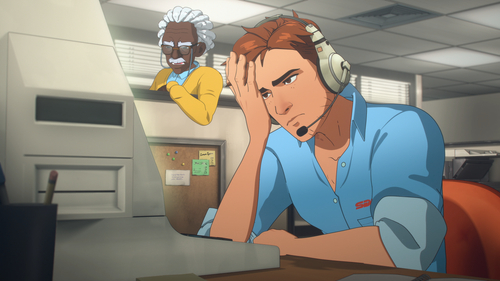
“Dispatch,” an original game by ADHOC Studio in partnership with Critical Role, is a choice-based game where players make decisions on behalf of Robert Robertson III, our main character. Robert is a third-generation hero committed to putting the villainShroud, the man who killed his father, in prison. We, the players, join him on a journey to repair his Mecha (robot) suit after an explosive crash that leaves him in a coma and unable to continue his legacy. Fortunately for him, the Superhero Dispatch Network (SDN) in Torrance, California, sends the living embodiment of “the golden age of superheroes” to help him: Blonde Blazer.
Blonde Blazer is a hero-for-hire who offers Robert a job at SDN as a dispatcher, an employee who sends heroes to emergency locations or to complete the requests of SDN’s clients. SDN is a company that corporations and individuals can pay to access superhero assistance, almost like an insurance or bodyguard agency. Although many clients abuse their power with ludicrous requests, as seen in the game.
At the end of episode one, Robert accepts his role as a dispatcher and is placed in charge of the Z-team, a group of redeemed supervillains turned good. Or more accurately, a group of villains trying to turn good.
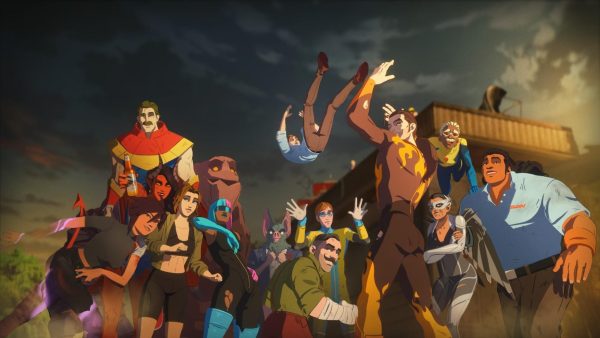
Now, obviously, this is not the entire game, but I want to delve deeper into something more than just a game description you could read on the Steam website. As someone who’s played four runs of “Dispatch,” there is so much I’ve come to appreciate about its character tropes and story progression.
My favorite aspect to analyze is, of course, Robert Robertson III. He is such an intense and compelling character, and you find yourself liking him for more reasons than just being the protagonist. Despite the fact that we make choices for him, choices that ultimately affect the game’s ending and create a trickle-down effect to later scenes and episodes, he is still his own person. He is not given insane plot armor; he gets hurt frequently, but he’s also not weak, nor does he fall into the whole “feeble normie” trope. He can hold his own and fight just as dirty as he can strategically.
What surprised me the most, however, was how emotional Robert can be, even when it’s not obvious. His generational trauma is, in my opinion, mightily overlooked by players who prefer to argue over his romantic interests. He can choose between two women, and while I’ll discuss one of them later, I think there is much more to be spoken about Robert’s adoration and resentment toward his father than there is about the speculation of his potential “soulmate.”
Robert says, “The family tradition, if there is one, is dying in that suit [the Mecha suit].” He doesn’t make an obvious show of disdain, but it’s clear he wishes to fight against the tradition that haunts his past. His father was killed because of the suit. His grandfather was, too. And while Robert wants to bring Shroud to justice, he also debates why he’s doing this. Why is he a hero? Why is he risking his life for a legacy that, quite honestly, scared him to come into?
It’s his loyalty. It’s his ingrained self-deprecation that tells him this is all he’s good for: to die as a martyr.
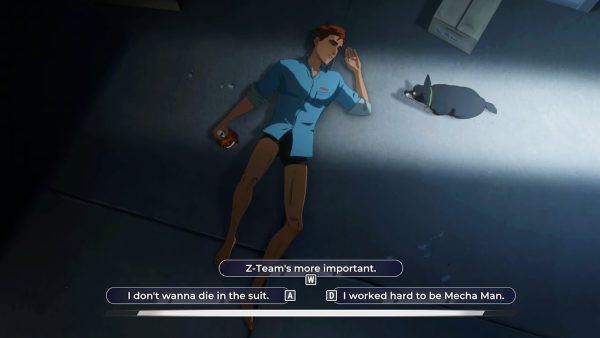
There is a choice in the game where Robert can either admit to his team that he’s the hero Mecha Man or where he can abandon that identity entirely and live as just Robert. I believe the correct choice, not in the game, not in my personal run, but for his character, is to let Mecha Man go. Robert will never be the kind of person to let innocents get hurt, but he has also been given the chance to leave his predetermined grave and say it wasn’t his fault. He can tell himself that he is sacrificing Mecha Man to make a team of powerful and potential superheroes the best they can be. Logically, he would find more peace in helping others earn a second chance at life than in dying, never having lived his own.
“The Z-team is more important.” He’s drunk when he says this. He’s contemplating why he became a hero and left nothing else for himself to be. But even when doing this, he is given the choice to say there is more importance in something other than his family’s legacy. We choose for him to say this or for him to care for the suit, but the fact that this is even a choice at all shows it is realistic for his character.
Every decision we make in the game is one Robert could make. But we get to decide the life we want him to have.
With that, however, there were choices I wish I could have desperately made but weren’t given. One, which was the most obvious on my part, was that I wanted the opportunity to romance Malevola. I mean, come on!! She is the most gorgeous woman a person could ask for! That being said, while this wasn’t really a hang-up for me in the game, more of a moment of self-inserting, my next analysis is rooted in what I genuinely believe would have been best for the following characters.
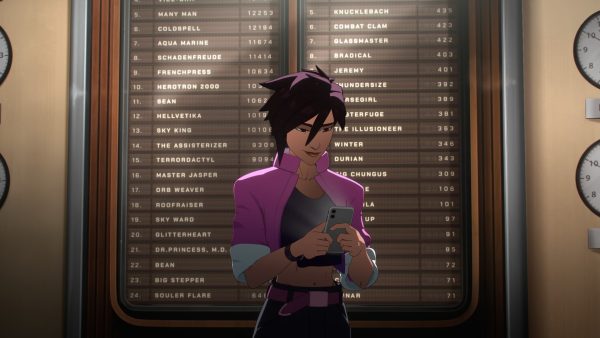
Visi, or Invisigal, is a spunky, sort of alternative, and beautifully crass woman. Yes, I am aware that calling someone “beautifully crass” sounds odd, but her constant inappropriate comments or jokes regarding sex do genuinely bring small laughs out of me. She’s a loner (not really, but she convinces herself she is) and one of Robert’s mentees on the Z-team. Invisigal, as her name suggests, can turn invisible, though only for as long as she can hold her breath. She’s also asthmatic. A great combination, no?
She’s often easy to anger, hard to manage, and frustrating to work with. But beneath the very obvious defense mechanisms to protect herself, she craves approval. She wants someone to take her side, to stay even when she fails. Yet, she also never allows herself to leave the past behind.
Her redemption arc, if you get that ending, is too reliant on Robert. I think I would understand more if she were a younger character, but she’s introduced as 26. She’s immature for her age, but she’s smart, and it’s obvious that immaturity is another way to keep people away from poking into her life and finding secrets she’s not ready to share, even if one of those secrets is that she’s emotionally starved and yearns for a viable connection.
I believe the reason I see her relationship with Robert as a “conflicting” part of her redemption is that she is offered as a love interest. There would be nothing wrong with this in another circumstance, but he is her superior. Her mentor. I fear that even if you don’t pick her as a love interest, it’s obvious how badly the game wants to push Visi towards Robert. Yes, she seeks Robert’s approval more than, say, Flambae or Coupé, but even when not romantically involved, she acts in ways that suggest she still wants Robert romantically: touching his face as they dance together, or if he dances with Blonde Blazer instead, looking at him longingly from across the room. Episode four even starts with a snippet of Invisigal’s explicit dream about Robert, which blatantly signals the developers’ bias toward her as the preferred love interest.
I like Visi’s character. I like what she represents, the chance to start over, even after the worst you’ve done, but I wish we got to see her rely on the entire group for support instead of just one person. Blonde Blazer says multiple times that she sees potential in Invisigal and that she wouldn’t allow her to be cut from the team. Golem defends her against the team during episode seven. Even Flambae does so, as well, if you (playing as Robert) make the right choices. Lastly, everyone cheers for her when she catches Lightningstruck (villain). Even if one hero has an ulterior motive, which depends on the scene you get, the rest were sincerely being kind.
We see the roots of a deeper connection both with the Z-team and with Blonde Blazer, yet we rarely see Visi actually rely on them. Besides throw-away comments from synergy (an aspect of the game that shows up when two heroes work well together), I think the rest of Visi’s relationships were set up for failure.
I find it hard to believe the Z-team wouldn’t be sympathetic to Visi when Chase was injured. I find it difficult that they would choose to boot her when she never intended to hurt someone she cared for, even if their relationship was rocky and barely standing. She sobbed, for crying out loud! She begged for him to stay alive. And yet, for the sake of the plot, the sympathy of the people she’s worked with for months was tossed out the window.
I find it unfair that her character depends on Robert for a happy ending. Yet, I understand that for the sake of the game, there had to be options to lead her astray.
Invisigal is a grown woman. She cannot be “neglected” by Robert for making her own choices, but she also shouldn’t be expected to rely on only one person for guidance. Even if he is her mentor, it takes a village to lead someone toward the right path. Their relationship is rooted in too much push and pull, and what they both need is something to keep them still long enough so they can breathe.
“Dispatch” is a great game. Don’t take my criticism as either an attack or support, but know that if a piece of media is good enough to inspire layered opinions from multiple audiences, it is something worth looking into. I’ve played this game for over 45 hours in the course of three weeks, and trust me, you won’t regret playing even for a minute.