
One would expect to wake up to a cool mountain breeze gently brushing across one’s face. Or at least to the sound of fresh glacial water dripping down a channel it has created. Well, if not that, then to the sound of fellow passerby, united journeymen in a trek to the base camp where we lived in our own shared microcosms.
You could insert any romantic idea into the thought of waking up at Rakaposhi base camp, a trip you made with your best friends. You would be wrong. We woke up to the sound of a rogue goat that had wandered into our tent and, for some odd reason, simply refused to leave, especially after slobbering all over and ruining our clothes, bags, and trekking sticks.
But that part comes much later. The truth is that two years ago, I saw a WhatsApp notification from Shirjeel, one of my closest friends. The message was a follow-up to our previous conversation, where we discussed mountaineering in North Pakistan. The proposal was tantalizing: explore the culture, meet new people, and eat what is widely acclaimed to be life-changing food on a week-long trip with your best friends. You’d be a fool to say no.
I said no. Sadly, circumstances do not care for how badly one wants to explore North Pakistan with their best friends. For months afterward, I heard nothing but stories about how life-changing the trip had been and how everyone had become an impassioned mountain climber. I would roll my eyes for months. That was until the conversation changed from “what a great experience” to “let’s do this again.” After last year’s sideline view of the mountains through screens, I was ready to make my way to the summits to make up for last time.
We planned meticulously. Screening tour guide companies, shopping lists, and a special emphasis on the absolute need for a raincoat and a large, heavy jacket to withstand the seemingly freezing temperatures that would be a given for this trip. The entire trip was planned from our moment of departure to the time we would pay the toll at the Ravi River, the final stop before we would return to Lahore.
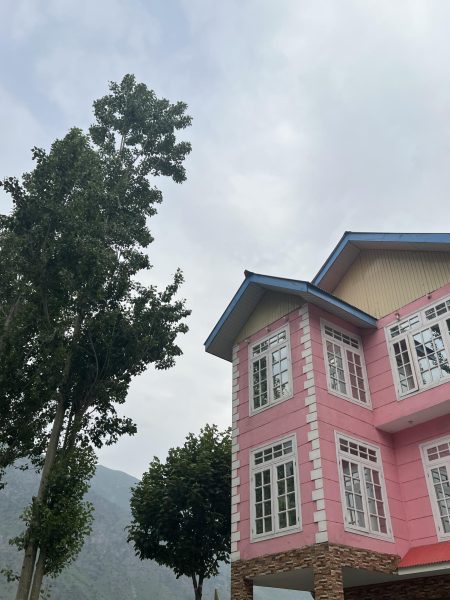
The trip was a seven-day ordeal: leave Lahore at night for Batakundi, where we stayed in an amazing hotel, which I can only remember by how pink the building was painted. From Batakundi, we had to make our way to a place called Minapin, from where we would start our trek to Rakaposhi base camp, which took us approximately 9-10 hours of total walking, which we broke down over two days. After trekking, we planned to explore Hunza, see the Passu cones, and eat dinner at the world-famous Yak Grill before heading home.
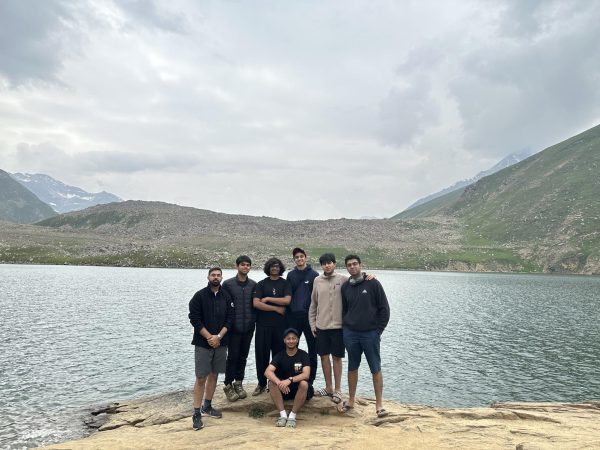
Not all went according to plan. But first, the people. The trip was largely planned by Saad and Shirjeel, two of the largest advocates for the trip. Hassan, our resident doctor, joined us for more than medical attention. Our friend, videographer, and drone pilot, Ali Sher, warmed another seat. Moazzam and Ibrahim, the Londoner duo, completed the guest list. We believed we had planned the trip perfectly, which catered to everyone’s schedules and to the fact that I would come back to Pakistan only after my finals had ended, which pushed the limit of interfering with Hassan’s schedule, who had to return to Qatar for some doctor-terminology-riddled thing.
The Complete Trek Timeline
The first wrench in the plan was an email I received at 3 a.m. about my 6 a.m. flight to Pakistan being canceled because of a plane issue. I had to get my flight switched to the next day, meaning I would leave for Rakaposhi the same day I landed. As soon as I landed, injected with an extreme dose of jet lag and excitement, unable to sleep, I started packing for the trip. After a last-minute shopping trip, I made my way to our designated departure spot with our travel company. Still no sleep and still intoxicated with the prospect of the next week.
After waiting for the always-late Saad Ahmad, we squeezed into a coaster van, connected our phones to Bluetooth, and settled into what would be our home for the next week. We spent the first 24 hours in the car, catching up, discussing the next part of the trip, and getting to know our new tour guide friends, Haseeb and Aqeel. Here, we discovered that Ali Sher knew far more about mountaineering than he let on, something that would later surprise us when he would trek at an insane pace, constantly, never stopping.
Over the next day and a half, we learned that our driver had never ventured as deep into the dangerous North Pakistan roads as we were about to drive through, something that was comically called an “easy scene” by everyone involved. This would be in tandem with issues with the car, which had to be stopped after the engine overheated. As annoying as you’d expect this to be, we didn’t mind the impromptu stops, since we were in, visually, one of the most beautiful places in the world.
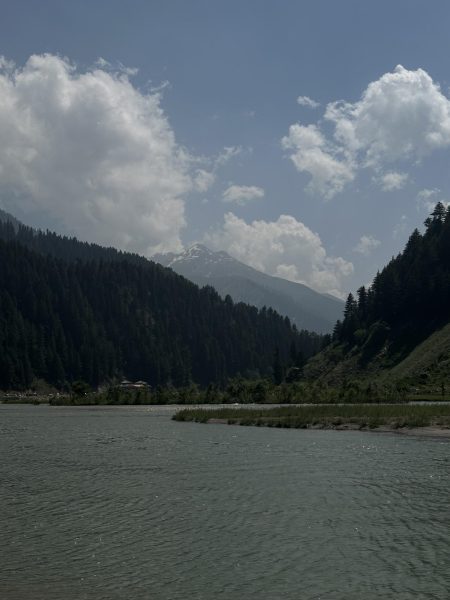
Upon reaching Batakundi, our first landmark stop, we checked into our hotel and explored nearby flower fields lining a mountain we couldn’t climb because of a tribe that did not take kindly to strangers coming to their homes. After a day of eating and a spontaneous walk to prepare for what lay ahead, we settled in for the night, waking up early for the next part of our journey.
Next, we stopped at Lulusar Lake, a famous tourist spot, where we took pictures and tried our best not to slip into the lake. We traveled uphill to the Babusar Top, a very famous tourist spot, where we stopped to eat crispy French fries and other local snacks. It was at this time that Ali Sher first piloted his cinematic drone, flying it over the lake and valley. We had an audience of some local boys who were playing nearby, who were curious about the inner workings of the drone.
Here, we first lost our friends, since only three of us stayed behind for the drone, while the rest went further uphill to find a bathroom and a shop to refuel our snack reserve. We moved the car uphill and went over to find them. After a long search, we would indeed find our missing friends and then proceed to lose where the car was, since it was not in the same place we left it. After an even longer search, we would be reunited with our ark, paddling us through the meandering North Pakistan roads. The driver was no Odysseus, but he would have to do.
Our next stop was a significant one. We had finally reached Minapin, where we were going to begin the trek. After a few wrong turns on roads already dangerously thin, narrowed by the recent landsliding, we reached our hotel, which was going to be both our starting and ending point. After packing up for our early morning start time for the trek, we slept like babies. Babies who would have to climb mountains the next day.
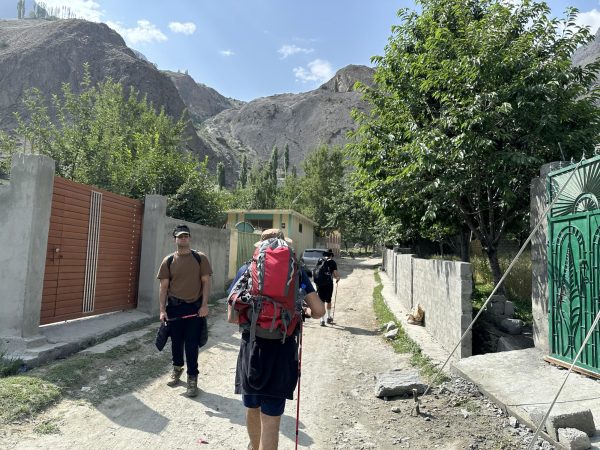
The first group of four was Shirjeel, Moazzam, Ibrahim, and me, who had started a few minutes before the others joined us. We walked from our hotel up a hill, across a bridge overlooking a river, before we signed our names in and officially started our trek. At first, it felt like we were climbing Everest, and the steep meanders were never-ending. Eventually, all of us caught up and then subdivided into two groups.
The first three hours were grueling, but were helped by an hour-and-a-half-long portion in the middle, which was flat, rocky land. We had a final steep climb to Hapakun, a place that marked that two-thirds of our journey was complete. My experienced trekker friends had already made their way there and were waiting for me and Saad to come tumbling alongside them.
As we caught our breath, we noticed that the final climb was going to be a steeper and more dangerous climb, but it was considerably shorter. However, since it was getting darker and more dangerous to make the next climb, we camped in Hapakun for the night. However, this was only after a near-death experience involving Shirjeel and Moazzam.
After deciding that we would camp here for the night, because of exhaustion and dimming daylight, Shirjeel decided to scout our path for tomorrow, which involved him going up a very steep hill of dirt, which was slippery and unreliable. This, we found out the hard way, when Shirjeel made his way down the hill and was unable to control himself, as he was sent rushing towards the edge of the hill, a fall that would have surely been fatal.
Enter Superman, whom we called Moazzam affectionately. Moazzam stepped directly in front of the rushing Shirjeel and grabbed them both, directing them towards the right so they would fall to the ground to their right, meaning they both escaped with minor injuries. This shook us for a while and prompted an entire night of reflective conversation, where essentially, we caught up with each other about all of last year.
The next day, we ventured forward after a delicious breakfast, one of Haider Bhai’s finer works. Haider Bhai was our local guide/chef/mystic shaman/philosopher/life coach/motivational speaker and one hell of a horseman. Haider Bhai was as raw a Northern Pakistani as you had. He joined us on our trek, arriving before us, despite leaving almost half an hour after we had left.

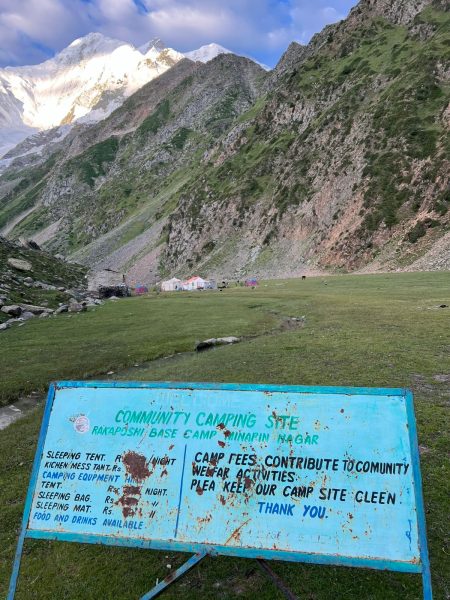
After three to four hours of trekking, we finally reached Pakistan’s “Shining Wall,” the glacial covers of Rakaposhi, in its flesh and all its glory. After spending some time on a hillside, touted as the best lookout area for Rakaposhi, we descended to the Base Camp, where I had one of the best naps of my life. After waking up, we moved back to the lookout to better see the glacier range.
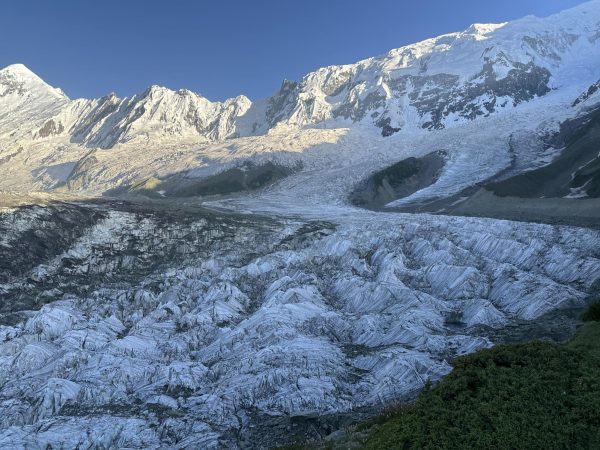
That night, we found out that Ali Sher had the worst top-three ranking of the Marvel films possible and then made our way to our tents before calling it a night. The next morning was when the infamous goat incident occurred. We replenished our water supplies with fresh glacial water and then set out back to Minapin, which we reached about half an hour after noon. Trek complete. The war was over.
After taking some time to recover with a cold shower and a quick snack, we made our way back to Noah’s Ark (our coaster van) and began the journey back to Lahore. This was only after we went to Hunza, exploring the forts and buying souvenirs. We stayed at a hotel overlooking the Passu cones, settling in after a day at Attabad Lake. To add to our unmatched luck, Yak Grill, the universally acclaimed restaurant where we had been itching to eat, was booked for the night.
Our only other option was a restaurant at the top of a hill, a walk we hated after continuously trekking for three days. The next day, we left for Batakundi again, our last nightly stop before we reached Lahore, culminating a week of exploring the North.
Interesting People and Stories
By far, the most interesting person we met was our local jack-of-all-trades, Haider Bhai. On our first night at the Base Camp, Haider Bhai made us a mystery pasta, the contents of which are still unknown to us, and seemed to us random, but to Haider Bhai, it was a calculated amount of every masala and sauce he had on his wooden shelf. The result was a soupy, noodly pasta that was better than anything any restaurant had ever made.
Haider Bhai was a suitcase of story-worthy anecdotes. Not only had he started his own restaurant ages ago, but the story of his falling out with a childhood friend and business partner, which led to the restaurant’s failure, was more interesting. His advice on getting married before the age of 24 or not getting married at all was questionable, to say the least. The perceived certainty with which he said it was almost convincing.
We heard stories of paranormal possessed cattle that would cause camping tourists and other cattle issues. Apparently, we had just missed the sighting of a snow leopard, which had made its way to the camps and eaten a couple of goats just a few days before, which obviously prompted everyone to tell every ghost story they had ever heard. Ali Sher’s drone footage captured a group of mountain climbers who were about to summit Rakaposhi.
Haseeb and Aqeel were a dynamic duo of travel guides. Aqeel bhai’s chain-smoking was a love language between him and the infamous ‘tobacco stick,’ his pet name for the pack of Dunhills he would pull out almost every chance he got. Stories of Haseeb’s friends and encounters with a foreign biker gang, who ended up living with them for weeks, more than the intended overnight stay, should have been made into a book.
As we were close to reaching the base camp, we met a random trekker, a Pakistani man who looked considerably older than we were and who we estimated to be at least 40. The man with a thin backpack started his trek after us and caught up to us much quicker than expected. He told us that he had just trekked from Minapin to Rakaposhi in half the time we had done it, and was going to make the return journey right then, only reaching the base camp as a turning-back point.
We also met a shopkeeper, whose name I forgot, a young man running a souvenir shop of traditional stones, jewelry, and traditional caps and garments. We bought all our souvenirs from him, and he told us he was a student of business studies at the local college. This reflected the commitment of the Hunzai culture and community to education. The area is famous in Pakistan for having a 100% literacy rate, and the people are sure to be among the kindest, smartest, and most welcoming people one is ever likely to meet.
A Final Reflection
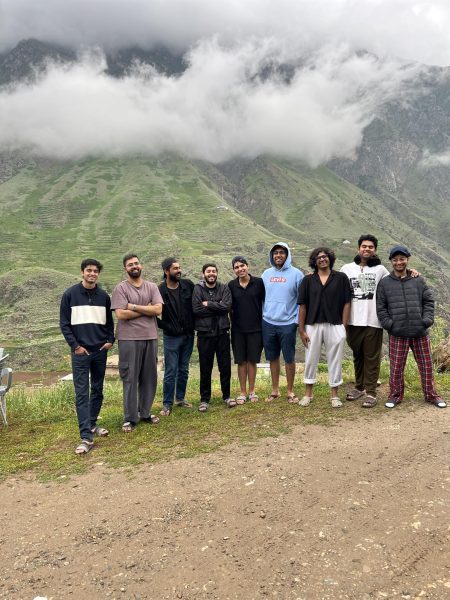
Before this trip, I imagined my friends’ descriptions of mountaineering/trekking trips to North Pakistan as “life-changing” to be an exaggeration. Hypocritically, I would also describe the experience as life-changing. Not only was the experience an opportunity to push ourselves to the limits physically, but it was also a necessary detox from our phones and any forms of screen and media.
Throughout our trip, and especially as we reached higher altitudes, we had no cell service and no internet. While we did use our phones to take pictures, play songs, and remain in communication with our families, our total time on the phone was considerably less than what our time would have been in a normal week.
The opportunity to interact with friends again, whom I hadn’t seen since I left for college, was priceless. The trip and the experience of essentially living with my best friends for a week were incredible. Not only did we get closer as friends—which I did not think would happen, since all of us were already like family—but the trip also allowed us to troubleshoot our friendship and fix unhealthy habits we had developed, something we could only realize after the clarity of mind that a trip like this offered.
Immersing myself in North Pakistan also allowed me to explore a part of Pakistan I was unfamiliar with. The food was some of the best I have ever had in my life (Moon Restaurant’s BBQ platter and Anatummy’s Dopamine Buns). The people were extremely welcoming, inviting, and full of kindness and warmth that extended to everyone. North Pakistan is steeped in rich culture, heritage, and history, and populated by a people who recognize the worth of humanity.