

I would not have thought to use the word “kindness” to describe an extension cord. Not until Oct. 10, when I sat in the Round Room in the Ford Center for Fine Arts among a few dozen people, listening to artist and poet Kelly Clare, ‘16, (she/they) discuss her homecoming art exhibit, “Power Cord.”
She was quoting a line by poet Ian Lockaby, noting one of the many “threads”—as she called her inspiration—that influenced her work in all its bright lines and unapologetic kitsch and glowing connectivity.
“Power Cord” opened Oct. 10 in Borzello Gallery. Clare majored in studio art and creative writing at Knox and then went on to earn their MA and MFA with honors in sculpture and intermedia at the University of Iowa.
Clare currently lives in Western Mass. and is also an editor of “Ghost Proposal,” an independent press that published Lockerty’s chapbook that Clare quoted earlier. In the talk, they reflected on why that quote meant a lot to them and inspired their work.
“I think the act of generosity of an extension cord…it is a beautiful, colorful thing, that on just a pure dopamine level, I think they’re beautiful. But they’re also an act of moving power and sharing power and overcoming the boundaries of a window or a door,” Clare said. “They’re used when you don’t have an outlet nearby that you need to move somewhere else. And there’s something really beautiful about that to me [that] ended up informing the work.”
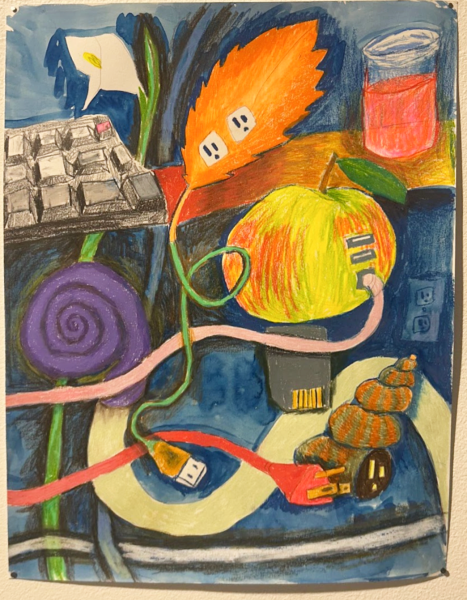
The pieces in this exhibit focus on what Clare calls “hidden infrastructure,” an example of which they describe as the wires and cables that are inside many structures but are often hidden from view.
“I love to think about how it’s always there, but we don’t see it unless something is broken or something is being repaired, something that’s [fallen] into disrepair. Those are the moments where we get to see this hidden infrastructure,” Clare said.
Her work makes these “hidden infrastructures” vibrant and beautiful rather than invisible. The pieces in “Power Cord” are playful, colorful, and even humorous, combining drawings, objects, digital collages, and even printed fabric.
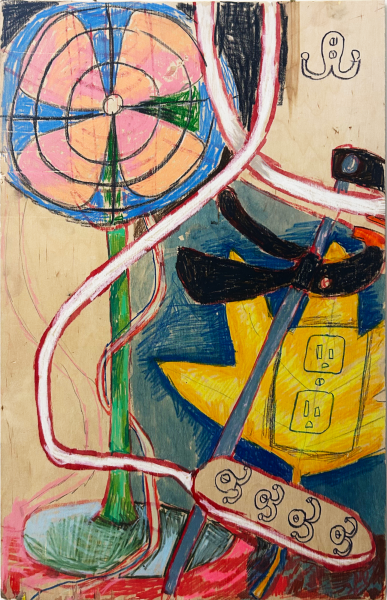
Clare’s inspiration and creation came from a variety of unexpected places, from maple syrup tapping to fluorescent construction flags, chenille bedspreads, and collections of shells gifted from many people. I thought it was lovely getting to hear about these “threads” and how they all came together.
I appreciated the detailed and narrative way Clare walked us through the evolution of their process. We could hear and see how a curiosity with the world’s “hidden infrastructures” grew into collections of drawings with cord motifs. Then, we see how repeating imagery from the drawings, such as shells, grew into physical creations, and even how the physical became functional, with cords and outlets running through shells in a way that delivers real power. Though Clare’s storytelling made this process clear to follow, their process is far beyond linear; it’s explosive. It’s chaotic. It’s awesome.
I was thoroughly captivated by Clare’s presentation, which felt like a warm invitation into her living room and into the different landscapes she made things in. I was in awe of how Clare could make me feel so drawn to different objects, such as a collection of wires, a computer monitor adorned with shells, and a light switch. I felt the humanness of the objects and the care with which Clare made them.
It was also interesting to hear how connection is an important theme of her work over time and how she found creative ways to connect through her art during the isolation of the Covid-19 pandemic. I see a pulse of connection throughout “Power Cord,” too, as she explores the concept of literal and symbolic, electric and human, connectivity.
After the presentation and Q&A session, people filled the gallery and admired the pieces.
I think the exhibit is absolutely electric (pun intended). The bright colors bring a warmth to the space that feels inviting and fun. I love the way the pieces complement each other, feeling cohesive, while still having something new to discover in their differences.
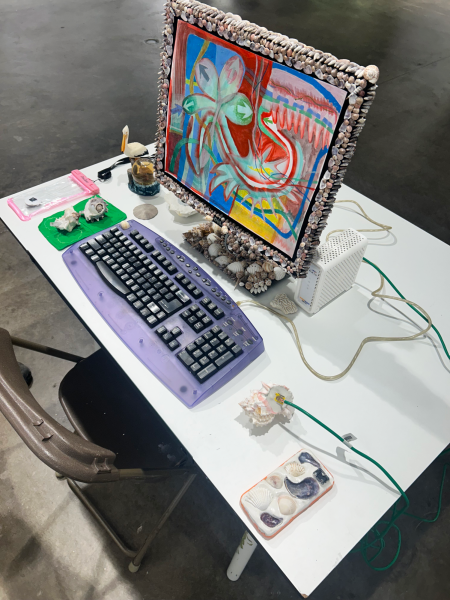
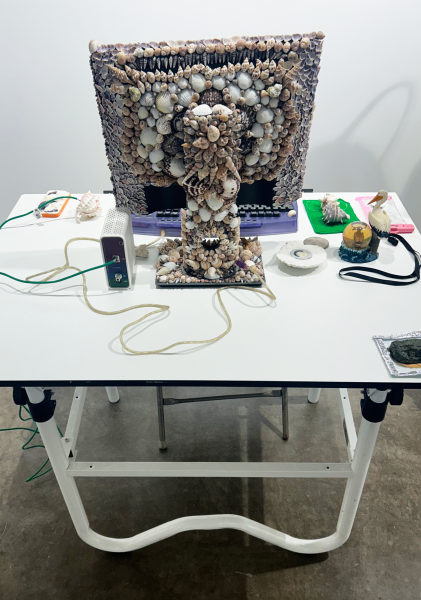
One of the standout pieces is one Clare mentioned in her presentation: a computer adorned with shells in a ripple of texture, art covering the screen, surrounded by an assortment of objects. Something about the arrangement of the shell layer is very satisfying, like I wanted to run my fingers along it.
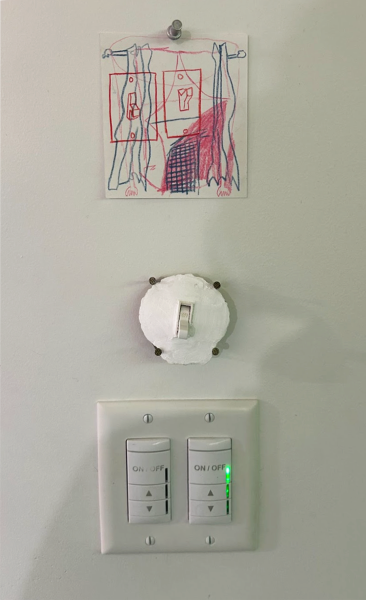
Small drawings are arranged just above the floor. Some are actually on the floor. There is an intentionality to the arrangement of the gallery, but it feels fun and unserious. It feels like, by looking at the pieces, we are following lines of power cords across the floor or looking at where an outlet might be on a wall.
In both Clare’s talk and the Q&A session afterward, the term “kitsch” kept coming up. Kitsch, which comes from a German word, is a term used to describe things that could be seen by some as tacky but that often have a humorous or quirky quality. I could feel the kitschiness in layers through the gallery. It felt homey.
“I think it’s goofy, but I also think there’s something very sincere about it(…)” Clare said in the talk. “There’s something heartfelt and sincere about kitsch at its core that I think I’m attracted to this sort of goofiness. There’s a sort of camp to it, too. But I think it’s always, at its heart, actually very sincere. I think that’s what I love about it.”
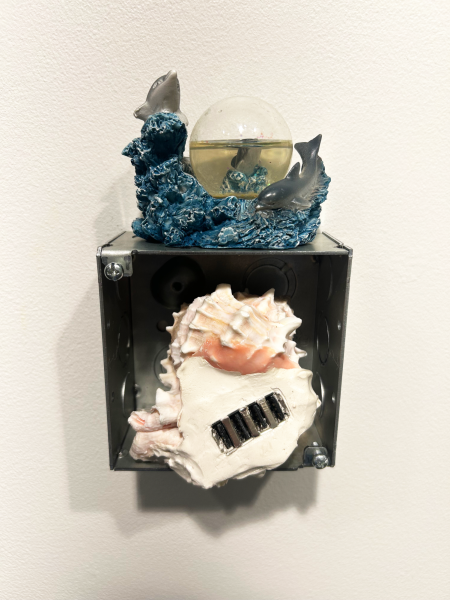
I liked the combination of physical with digital. While I found myself most interested in the drawings and physical objects, the digital art was still mesmerizing in its layers and movement. There are connection points linking the 3D cords and objects to the 2D drawings and digital images.
Overall, I’m grateful for the opportunity to listen to Clare’s process and inspiration and the joy I felt exploring the exhibit afterwards. I love the repetition of symbols—from ampersands to arrows, fans to carabiners, and of course, the shells—while there was still always something new to discover as I moved throughout the gallery. The bright colors, twisting lines, and overall aesthetic unapologetically highlight objects we don’t normally celebrate, drawing me in until I found myself sitting in front of the pieces, immersed in a kitschy, playful, yet thoughtful world of connectivity.
“Power Cord” will be on display in Borzello Gallery until Nov. 23. Take some time to check it out if you can.