

“Drive” (2011) turns violence into a spectacle. Despite the inclusion of vivid images with bloodshed and murder, Nicolas Winding Refn’s filmmaking is defined by a peaceful, melancholic, and nostalgic visual aesthetic; marked by soft lighting, slow motion, and the extensive use of silence.
The main character, the unnamed Driver (Ryan Gosling), reflects these elements in his very presence. The Driver’s demeanor is quiet, shy, almost delicate. He speaks very little, and when he does, his voice is only a tad above a whisper. His expressions are minimal, and when he smiles, it’s always a little sad. However, hidden within the Driver’s peaceful and melancholic nature, there is his prevalent brutality. He proves himself more than capable of threatening and committing cold-blooded murder.
Yet, the beauty in the film’s aesthetic, which the Driver embodies, leads the viewer to pay less attention to the violence itself and more to the striking visual composition of each scene. This makes the violence not only tolerable but strangely beautiful. In this way, the viewer looks past elements that might otherwise make them dislike the Driver more and chooses to side with him.
Carl Plantinga, using Murray Smith’s theory of character engagement, explains some reasons why this is the case. Plantinga identifies a “pro” attitude towards characters as an “allegiance,” according to Smith’s terminology. Usually, allegiance occurs when we perceive a character as good. Plantinga argues that motion pictures “are able to exploit a central human weakness—the inability to distinguish, in many cases, moral from nonmoral judgments” (46).
Thus, according to Plantinga, rather than a deliberate evaluation of a character’s morals, the spectators consider what they see and feel while watching a film as the standard for favoring a character’s morals or not. This opens the possibility for filmmakers to manipulate the audience’s views of a character’s morality. That is exactly what is seen in “Drive”, where the cinematography brings to violent scenes a beauty so potent that the spectator is tempted to side with the character who caused it—the Driver.
One key example is the scene where the Driver threatens Blanche (Christina Hendricks)—one of the people involved in the pawnshop robbery that the Driver agrees to help with—in the hotel.
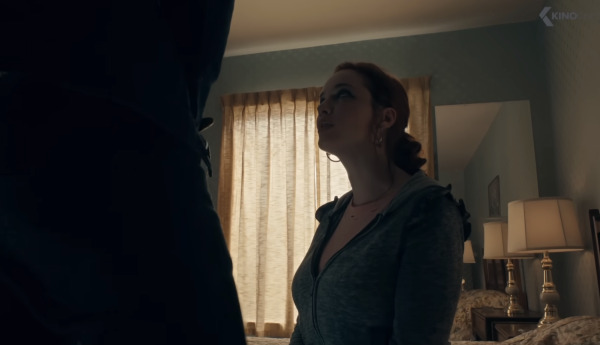
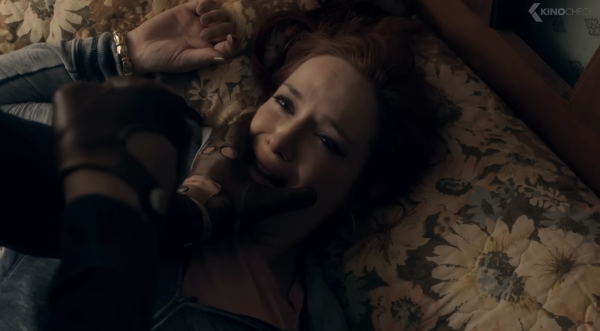
The lighting is low-key. The curtains filter the golden sunlight, giving the space a fake sense of warmth, safety, and comfort. When the Driver attacks Blanche, it’s abrupt, unexpected, but still quiet. “Now, you just got a little boy’s father killed. And you almost got us killed. And now you’re lying to me,” he says. His voice is soft and unthreatening, like he is telling her something trivial, like the weather. Blanche is lying on floral print sheets—literally a flower bed. The sun shines, golden, on the side of her face. The beauty and coziness of the scene distract us from the fact that the Driver is being violent to a defenseless woman.
The same happens later once the violent gangster Nino’s hired thugs break into the motel and shoot Blanche dead from the bathroom window. The Driver brutally slays one of them with the metal shower curtain rod to the chest, but the cinematography remains beautiful. The blood splashes from the wound in perfectly round, scarlet drops, which shine against the yellow light and rain down in slow motion.
When the Driver ultimately gets the gun and shoots the other thug, we see a shot of his face covered in blood, peeking from the bathroom. Blanche’s blood splashes on the bathroom walls, almost perfectly mirroring the blood on the Driver’s face. Although we see violence in the Driver, we are constantly reminded where that violence came from—he had no choice but to act that way, since these people were violent first. As Platinga suggests, this makes him moral in our eyes, which helps us develop allegiance towards him.
We then get a shot of the state of the hotel, with one of the thugs’ bodies, the mattresses and curtains splashed with blood. However, the soft lighting from the window, which reflects on the camera, creates a beautiful sense of peace and calm. Despite the violence that just occurred, we feel at ease now that we are alone with the Driver. We forget all we know about morality and feel glad that he killed those people, because it has allowed us to relish in this golden feeling.
Through that, the film seduces the viewer into the grotesque, the brutal, and the horrible since it is all arranged beautifully, wonderful to look at.
Works Cited
Drive. Directed by Nicolas Winding Refn, performances by Ryan Gosling, Carey Mulligan, and Bryan Cranston, FilmDistrict, 2011.
Plantinga, Carl. “‘I Followed the Rules and They All Loved You More’: Moral Judgment and Attitudes toward Fictional Characters in Film.” Midwest Studies in Philosophy, vol. 34, no. 1, 8 Sept. 2010, pp. 35–51.