

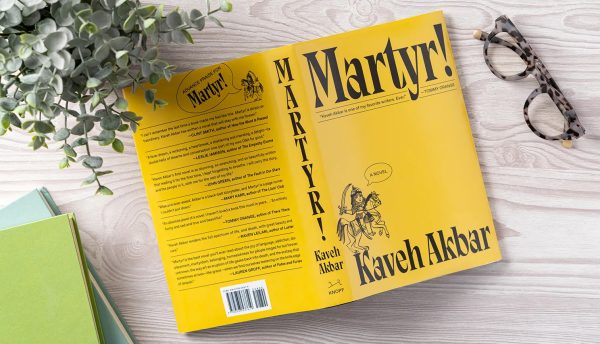
Cyrus Shams is Kaveh Akbar’s gripping subject in his debut fiction novel, “Martyr!” The work marks a first for Akbar, an Iranian-American poet known for works like “Calling A Wolf A Wolf.” According to Akbar, he considers his novel to be a companion piece to “Calling A Wolf A Wolf,” given that both works deal with serious issues like substance abuse.
However, it is not reasonable to say that “Martyr!” simply deals with substance abuse. The thematic conversations of the book are too varied and chaotic to reduce to simpler labels. This chaos complements the chaotic, flawed, fragmented, and flayed nature of the protagonist, Cyrus Shams. Much like Akbar, Cyrus is an Iranian-American immigrant, wanting to be a writer and a poet. The book blends aspects from Akbar’s real experiences during his time in college and his childhood.
“Martyr!” Follows Cyrus Shams, a young man who struggles with addiction and alcoholism. When we first meet Cyrus, he is enrolled in a rehabilitation program and is working odd jobs to support himself. His job as an actor for medical students echoes very “Fight Club” like sentiments, where the protagonist also attends random group therapy sessions, and odd groups to combat his crippling insomnia.
Later, after attempting suicide and feeling a general frustration with the rehabilitation programs, he starts to deprioritize his rehab programs. Here, we reconcile Cyrus as a man searching for purpose, an artist searching for a muse. He navigates his experience as an immigrant, losing his mother at an early age, and then later his father, with issues regarding his faith and religious beliefs. Cyrus is a mixed bag.
Eventually, he concludes that his magnum opus is to be a book about death and what it means to be a martyr. Excerpts of Cyrus’s book are intertwined with Akbar’s retelling of Cyrus’s story to search for his own meaning of life and to assign a meaning to death. His friends inform him of an artist who is terminally ill, and as her final exhibition, is living inside an art gallery and inviting strangers for conversation. Cyrus is encouraged by his friends, including Zee, whom he sometimes hooks up with, to visit this artist to work on his book. He decides to do this.
In his conversations with the artist-in-residence (quite literally), he uncovers personal truths, navigating his personal sentiments with his childhood, heritage, and the experiences that come to redefine death and martyrdom for him. The book incorporates many real-life elements, both from Akbar’s life and other historical sociopolitical issues, including the tragedy of Iran Air Flight 655, which he incorporates into his mother’s death.
The book can best be described as a mosaic of writing styles, themes, and character storylines. In his writing style, Akbar’s poetic prowess shines through. Some chapters are completely written as poetry, presented as excerpts from his book. Other chapters include radio transmissions and news about Iran Air Flight 655. Personally, I found the insomnia-induced hallucinogenic conversations my favorite unconventional writing risk taken.
Cyrus also suffers from chronic insomnia, which he deals with by having imaginary conversations between fictional (and sometimes real) characters in his life. From Batman and Lisa Simpson to basketball legends and even the unnamed President of the United States, the conversations reflect his inner questioning and divided self. I found this portion to be the most entertaining and creative portion of the entire book. The balance between managing iconic characters, such as the ones Akbar uses, while reaffirming his voice as a writer, is genius.
The book dives into themes of religion and faith well. Cyrus confronts themes of Shia Islam, his birth religion, which has a heavy emphasis on martyrdom. This makes his obsession with defining martyrdom and glory more natural and adds a layer of history and religion to the larger conversation. The most interesting product of this was the character of Cyrus’s uncle, Aarash, his mother’s older brother, who was a wartime soldier for Iran, tasked with riding alone in the night, wearing a robe and carrying a sword to reaffirm religious sentiments for dying soldiers.
Themes poignant to Shia Islam are dealt with excellently in the book. Aarash’s character is based directly on Shia Islamic imagery and connects Cyrus’s obsession with martyrdom to the emphasis on martyrdom and death in Shia Islam. Other aspects of Aarash line up with accounts and reports of wartime propaganda by both Iran and Iraq. Aarash is shown to be the prime victim of propaganda used to incite war.
Although war is not a central theme of the book, it certainly acknowledges the effect war has had on people of countries like Iran, who have had a difficult history with war and violent conflict. These portions are done really well. The backdrop of the Iran-Iraq war, layered with religious imagery, made Aarash’s character more intriguing. Aarash’s struggles with PTSD and stress following the horrors of war are both meaningful and poignant.
In terms of writing style, Akbar’s poetry background takes center stage. I found Akbar’s writing to be very momentum-dependent and tension-significant. This is a thematic necessity for a book that explores the kinds of topics Akbar tackles. At times, Akbar’s writing masters hold and change of momentum and tension to the requirements of the book. Other times, however, he seems to abandon that control altogether. In a flashback sequence detailing an incident involving Cyrus’s mother and uncle, there is a nearly three-hundred-word-long sentence that completely tears the tension and momentum that Akbar spends pages building.
Akbar was inventive. The prose has no singular style or consistent structure. Chapters are interwoven with traditional prose, poetry, transcripts of news segments, and excerpts from official documents. The decision to add the names of characters that the chapters focus on next to the chapter number was a clean and effective trick to help the readers follow a vast array of characters and not get overwhelmed in trying to keep up with which character the chapter follows.
The fragmented structure of the book reminds us of Cyrus’s identity crisis and the many fragments and structures he embodies. The book reads as if Cyrus’s mind were a Google Chrome window, with multiple tabs open, and the reader is flipping through all of them. This structure connects to Cyrus’s characterization as well as the complexity underlying the narrative.
Akbar’s dark, witty humor shines through in an understated way. The book is rich with culture and tradition and sharp critiques of both Iranian and American culture. While the book acknowledges the depth of culture and customs of both Iran and America, and the immigrant’s blend of both, it does not shy away from criticizing shortcomings and logical fallacies.
The book also deals with queer romance and relationships very well. In fact, the book’s queer relationships are even more developed and rewarding than the contrasted heterosexual relationships. Cyrus and Zee are exceptionally close best friends who also hook up often. Zee is clearly in love with Cyrus, who does not realize it. The book’s portrayal of queer relationships as tender, loving, and as wavy as any other relationship (if not more) is a great aspect of the book.
The book has many open-ended loose threads, especially by the end. On account of this, the book posed many unanswered questions that puzzle readers even today. Everyone has their own analysis of the final ending of the book. On my first read, I disliked the ending profoundly. I thought it was too abrupt and came too out of left field to make sense. The ending can be interpreted as being reductive and abrupt, which is disappointing, considering the book evolves to be the antithesis of that.
However, on my second read, I appreciated the ending a little more. Many fan theories emerged from the ending and the ambiguity of it, which I thought was appropriate, given that the core tenet of the book was about the ambiguous and undefined nature of death and martyrdom. In an attempt to make this review spoiler-free, I will not reveal what I think about the end, but I hope this encourages the reader to pick up the book and define it for themselves.
My final rating for “Martyr!” is 8.7/10.


